AI Agents vs Chatbots: Why Static Chat Is Holding Your Business Back
On this page
Your competitor’s ‘AI agent’ just handled a refund request, updated the CRM, sent a confirmation email, and flagged the account for a follow-up call — all before a human touched the ticket. Your chatbot asked the customer to press 1 for billing.
That’s not a capability gap. It’s an architecture gap. And if you’re evaluating AI tools right now, knowing the difference will save you from deploying the wrong thing — then wondering why the results don’t match the vendor deck.
Here’s the thing most comparisons skip: it’s not about which tool is smarter. It’s about whether the tool operates in a loop. That single concept explains everything — why chatbots fail when they fail, why agents can handle tasks chatbots can’t, and why so many ‘AI agents’ you’re being sold are still chatbots underneath. I’ll get to that last part after the framework.
Why Chatbots Still Dominate (And Why That’s a Problem)
Chatbots have been around since Joseph Weizenbaum created ELIZA in 1964. The concept hasn’t changed as much as the marketing would suggest. A developer maps conversation flows: if the user says X, respond with Y. If they click button A, show menu B.
That architecture works well for exactly one category of interaction: simple, predictable questions with known answers. Business hours. Return policies. Pricing tiers. The chatbot is an interactive FAQ with a friendlier interface.
The moment a customer asks something outside that script — ‘I ordered the wrong size, can I swap it before it ships?’ — the chatbot does what it always does: escalates to a human. That’s not a bug. It’s a ceiling. The exact line where chatbots end and something fundamentally different begins.
The deeper problem: 81% of customers expect faster service as technology improves, and 73% want better personalization. Static scripts can’t deliver either. The ceiling isn’t just a technical limitation — it’s a business risk.
The Loop Is the Difference: What Actually Makes an AI Agent an Agent
Here’s the architectural reality. A chatbot performs one operation: prompt in, response out. That’s the whole loop — except it isn’t a loop, it’s a single step.
An AI agent does something structurally different. It reasons about what needs to happen, takes an action (calls an API, reads a file, queries a database, sends a message), observes the result, and then decides the next step. The loop repeats until the task is complete.
Chatbot Pattern
Input → process against script → output. Single exchange. No memory of what just happened. No ability to act on other systems. Conversation ends when the script runs out.
Agent Pattern
Input → reason → act → observe → reason again → act again → output. Multi-step. Connected to tools, APIs, and databases. Continues until the task is actually done.
The gap between these two architectures is roughly the gap between a phone tree and a skilled human employee. They both answer the phone. The similarity ends there.
A chatbot defines a sales territory when you ask it to. An AI agent prioritizes the regional prospects for the day and drafts the outreach emails. Same starting point. Completely different ending.
What the Marketing Won’t Tell You: Most ‘AI Agents’ Are Still Chatbots
This is the part that matters if you’re currently evaluating tools.
Most products marketed as ‘AI agents’ in customer support, help desks, and FAQ systems are functionally chatbots. The interface is nicer. The knowledge base is bigger. The response sounds more natural. But the underlying pattern is unchanged: one question in, one answer out. No loop. No action. No adaptation.
The test is simple. Ask the vendor: does your system take actions, or does it provide answers? Can it update a record in my CRM without a human approving every step? Can it send an email, check inventory, and route a case — all in one task? If the answers are vague, you’re probably looking at a chatbot with better marketing.
The resolution rates tell the story. Traditional chatbots resolve 30–40% of customer requests before handing off to a human. AI agents with actual loop architecture resolve 70–85%. That’s not a marginal improvement. It’s a different category of tool.
A Practical Framework for Choosing the Right Architecture
The wrong choice has direct consequences. Building an AI agent when a chatbot would have worked adds unnecessary complexity, latency, and cost. Deploying a chatbot when you needed an agent leaves significant value unrealized — and generates frustrated customers in the meantime.
Here’s the decision logic we use.
Use a chatbot when the interactions are predictable and structured — hours, policies, common FAQs, booking confirmations. The task has a known set of inputs and a finite set of correct outputs. The chatbot handles it reliably, at low cost, with no surprises.
Use an AI agent when the task requires action across systems, adaptation to variable inputs, or judgment about what to do next. Cross-functional workflows. Anything that currently requires a human to coordinate between tools. Tasks where the ‘right answer’ depends on what happened two steps ago.
Where AI Agents Fall Apart: The Tradeoffs Nobody Leads With
AI agents are not automatically better. They’re more powerful, which means they’re also more dangerous when misconfigured. Here’s what breaks.
- Permissions creep. An agent with too much system access can cause real damage — deleting records, sending unintended emails, or overwriting data. Enterprise-grade agents require least-privilege permissions: the agent gets access only to what it needs for the specific task, nothing more.
- Auditability gaps. A chatbot conversation is easy to review. An agent’s multi-step reasoning chain is not. You need audit trails that capture every action the agent took, every tool it called, and every decision it made — especially in regulated environments.
- Latency at scale. The reasoning loop adds processing time. For high-volume, simple interactions (thousands of FAQ requests per hour), a chatbot’s single-step response is faster and cheaper. Don’t use an agent where a chatbot would do.
- Hallucination risk in action contexts. When a chatbot makes up an answer, the consequence is a wrong response. When an agent makes up an answer and then takes action based on it, the consequence is a wrong action — potentially irreversible. Human approval gates for sensitive steps are not optional; they’re architecture.
- Setup complexity. Chatbots can be deployed in hours. Agents require workflow design, tool integration, permission modeling, and testing at every step. The capability ceiling is higher, but the ramp-up cost is real.
How to Know Your Agent Is Actually an Agent
Whether you’re evaluating a third-party tool or validating what your team built, these signals tell you whether you have a real agent or an expensive chatbot.
- It takes actions, not just answers. Your system can update a CRM record, send an email, or trigger an API call — without a human approving every step.
- It handles multi-step tasks. A single user request triggers a chain of actions: check inventory → confirm order → send notification → log the interaction. The agent sequences these without human orchestration.
- It adapts when intermediate results change. If step two returns an unexpected result, the agent adjusts steps three and four. A chatbot can’t do this because it doesn’t have steps three and four.
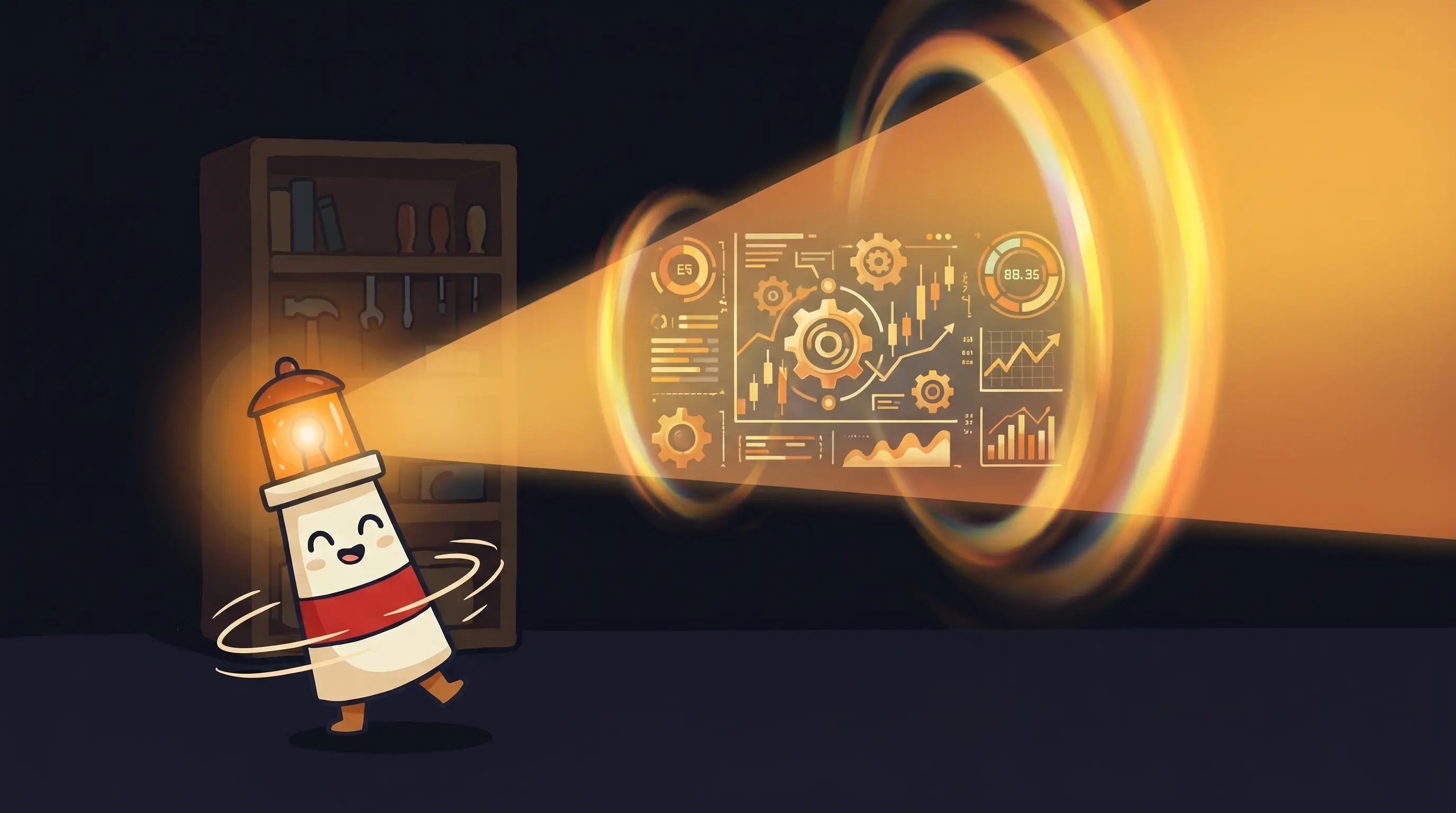
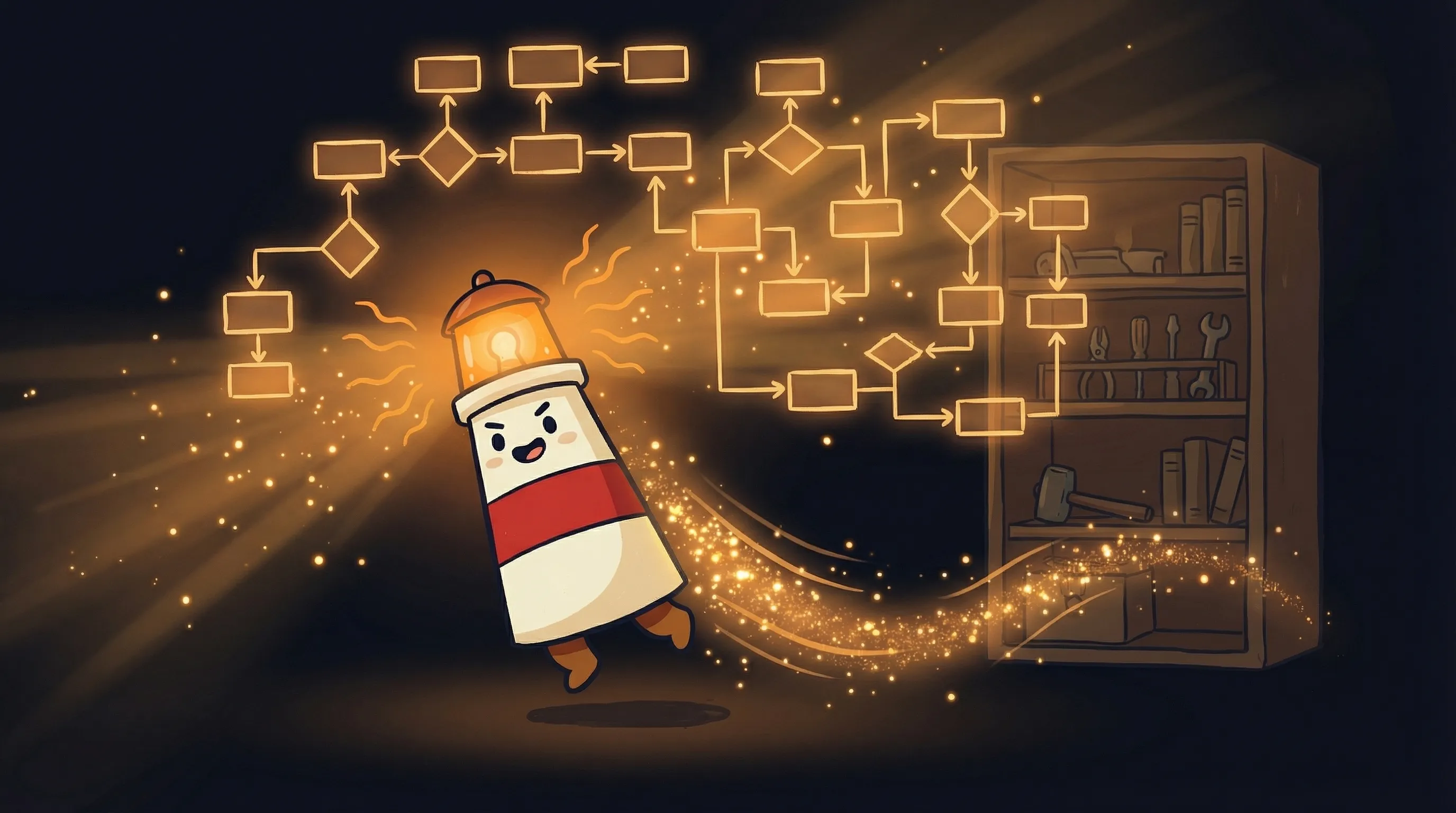 Beacon’s been doing the same thing for years — and it works. But your business deserves more than a light that just blinks on cue.
- It has memory across the task. The agent knows what it did two steps ago and uses that context to decide what to do next. Not just session memory — task-level continuity.
- It has an audit trail. You can review every action the agent took, in sequence, with timestamps. If you can’t, you don’t actually know what your agent is doing.
If you’re exploring agentic AI more broadly, this framework applies across every platform and use case. The architecture question is always the first one to answer.
Your Decision Checklist: Chatbot or Agent?
Run this before your next vendor conversation or internal build decision.
- Map the task. Write out every step a human currently does to complete this workflow. Count the steps. If there’s one step, a chatbot works. If there are three or more, you need an agent.
- Count the systems involved. If the task touches more than one system (CRM + email + calendar, for example), you need an agent. Chatbots don’t coordinate across tools.
- Define your escalation threshold. If you’re comfortable with the agent handling 70–85% autonomously and escalating the rest, agent architecture is appropriate. If you need human review on every action, start with a chatbot and add automation incrementally.
- Audit the vendor’s claims. Ask specifically: does the system operate in a reasoning loop? Can it take actions across multiple systems in a single task? If the demo only shows question-and-answer interactions, it’s a chatbot — regardless of what it’s called.
- Set permission boundaries before deployment. Define exactly which systems the agent can access and what actions it can take without human approval. This isn’t optional — it’s the difference between a useful agent and a liability. For sensitive steps (payments, deletions, external communications), require explicit human approval gates.
- Budget for the complexity gap. Chatbots can be live in days. A properly scoped agent deployment typically takes weeks to map, integrate, and test. If your timeline doesn’t account for this, you’ll cut corners on permissions and testing — and pay for it later.
- If you’re not sure, start with a chatbot and instrument it. Track where it escalates to humans. Those escalation points are your agent roadmap — the exact places where loop architecture would have handled the task autonomously.
For more on what genuine agent deployments look like end-to-end, the best AI agents comparison covers how these architectures play out across real platforms.
One more consideration: if you’re building toward a personal or business AI agent platform, the architecture decision above applies at the infrastructure level too — not just the application layer.
What This Means for Your Automation Roadmap
- Chatbots and AI agents are different architectures, not different versions of the same technology. A chatbot performs single-step exchanges. An agent reasons in a loop, takes actions, and adapts based on results.
- Traditional chatbots resolve 30–40% of customer requests autonomously. AI agents with loop architecture resolve 70–85%. The gap is architectural, not a matter of which model is more intelligent.
- Most products marketed as ‘AI agents’ in 2026 are functionally chatbots. The test: does it take actions across systems, or does it provide answers? One question in, one answer out is always a chatbot.
- The right choice depends on task complexity. Predictable, single-step interactions → chatbot. Multi-step, cross-system workflows requiring judgment → agent. Building the wrong one costs you complexity, latency, or capability.
- Enterprise-grade agent deployments require least-privilege permissions, audit trails, and human approval gates for sensitive steps. Skipping these isn’t a shortcut — it’s a risk you’ll pay for in production.
The question isn’t ‘chatbot or AI agent?’ as if they’re competing products on a shelf. It’s ‘does my task require a single answer or a sequence of actions?’ Answer that, and the architecture choice makes itself.
The teams that get this right aren’t necessarily using more sophisticated tools. They’re asking better questions before they build. That’s the entire edge.
Frequently Asked Questions
Can a chatbot ever be upgraded to an AI agent?
Not really — it’s an architectural replacement, not an upgrade. A chatbot is built around scripted flows and single-step exchanges. An AI agent is built around a reasoning loop with tool access. You can add AI-powered responses to a chatbot and make it smarter, but you can’t give it agency without rebuilding the underlying architecture. If your current chatbot handles FAQ-level interactions well, keep it for those. Build an agent for the workflows that require action.
How do I know if a vendor's 'AI agent' is actually a chatbot?
Ask two questions. First: can it take actions across multiple systems in a single task without human approval for each step? Second: can it observe the result of one action and decide what to do next based on that result? If the answer to either is no — or vague — you’re looking at a chatbot with better marketing. Ask to see a demo where the agent handles a multi-step workflow that touches at least two systems. That will tell you more than any spec sheet.
Are AI agents more expensive than chatbots?
Yes, in most cases — both to build and to run. The reasoning loop requires more compute per interaction, integration work is more complex, and proper permission and audit infrastructure takes time to set up correctly. That said, the ROI comparison changes quickly when you factor in resolution rates. A chatbot that escalates 60–70% of interactions to human agents carries its own cost. The right question isn’t ‘which is cheaper?’ — it’s ‘which is cheaper for this specific task at this volume?’
What tasks are chatbots still the right choice for?
Predictable, high-volume, single-step interactions. Business hours, pricing information, booking confirmations, password reset flows, FAQ responses. Anything with a finite set of known inputs and a scripted set of correct outputs. Chatbots handle these reliably, at low latency, and at significantly lower cost per interaction than agents. Don’t use an agent where a chatbot would do — it adds complexity and latency with no benefit.
What guardrails does an AI agent need before going to production?
At minimum: least-privilege permissions (the agent accesses only what it needs for the specific task), an audit trail capturing every action taken, sandboxed testing before any production deployment, and explicit human approval gates for sensitive operations — anything involving payments, deletions, external communications, or access to personal data. These aren’t optional security features. They’re the baseline for a deployment you can actually trust.
Sources
- Chatbot.com — AI Agent vs. Chatbot: What’s the Difference?
- Salesforce — AI Agent vs. Chatbot
- BuiltABot — AI Agent vs Chatbot: Key Differences Explained (2026)
- Ada — Chatbot vs AI Customer Service Agent
- GetAIBook — AI Agents vs Chatbots: What’s the Difference?
- AI Genesis — AI Agents vs Chatbots: The Real Difference Explained
- Skywork — AI Agents vs Chatbots: Why Agents Feel More Alive