An AI Personal CRM That Builds Itself From Your Email
On this page
You walked into that call last Tuesday and spent the first two minutes pretending you remembered who this person was. You’d emailed them four months ago. They’d introduced you to someone useful. You had no idea.
That’s not a memory problem. It’s a system problem. The average professional knows over 600 people, and there’s no human brain on earth that can hold 600 relationship histories — who needs follow-up, who referred whom, when you last spoke, what you promised. Expecting to track that manually is like expecting a spreadsheet to send itself.
I’ve watched this failure mode play out across every industry. Smart people, good intentions, zero infrastructure for their own relationships. The fix isn’t a fancier app you have to remember to open. It’s software that reads your email and calendar every morning and builds the picture for you. In a minute I’ll show you the counterintuitive part — why this only needs six database fields to work better than any manual system you’ve ever tried.
Why Manual Relationship Tracking Always Fails
The problem isn’t discipline. The problem is timing. You meet someone at a conference. You follow up. Six weeks later, something relevant happens and you should reach out — but the connection has gone cold in your memory. By the time you remember they exist, the moment has passed.
Google Contacts stores a name and a phone number. It has no idea you emailed this person three times last quarter, that they’re a potential client, or that they mentioned they were changing roles. Traditional contact apps only store details — they can’t surface patterns, flag stale relationships, or brief you before a meeting.
The data you need already exists. It’s sitting in your Gmail and your calendar right now. Every email thread, every meeting invite, every reply — it’s all there. The gap isn’t information. It’s a system to read it, organize it, and surface it when you need it.
What an AI Personal CRM Actually Does
Here’s the model. An AI personal CRM isn’t a database you fill in. It’s a workflow that runs on a schedule and fills itself in.
The workflow this article walks through, built on OpenClaw, works in two phases. The first phase runs at 6 AM every day. The second runs at 7 AM. They do different jobs.
- 6 AM — Contact Discovery: The agent scans your Gmail and Google Calendar for the past 24 hours. It extracts new contacts it hasn’t seen before, updates existing records with new interactions, and logs meeting and email activity with timestamps and context.
- 7 AM — Morning Briefing: Before your day starts, the agent checks your calendar for today’s meetings. For each external attendee, it searches your contact database and email history. It delivers a briefing to Telegram: who they are, when you last spoke, what you discussed, and any open follow-up items.
- On-demand queries: Any time you message your personal-crm Telegram topic with a question — ‘What do I know about Marcus?’ or ‘Who needs follow-up this week?’ — the agent searches the database and tells you everything it has.
The system connects to Gmail and Google Calendar using the gog CLI skill in OpenClaw. Contacts live in a local SQLite database — lightweight, fast, no monthly fee. The Telegram integration is the interface: you ask questions in plain language, you get answers.
If you’re exploring AI automation workflows that actually run on a schedule rather than waiting for you to click something, this is the canonical example of what that looks like in practice.
The Part Nobody Tells You: Six Fields Beat Every Manual System
Here’s the counterintuitive thing I promised earlier. The schema that makes this work has exactly six columns.
CREATE TABLE contacts (
  id INTEGER PRIMARY KEY,
  name TEXT,
  email TEXT,
  first_seen TEXT,
  last_contact TEXT,
  interaction_count INTEGER,
  notes TEXT
);
Six fields. Name, email, when you first encountered them, when you last contacted them, how many times you’ve interacted, and notes. That’s it.
Most people assume a ‘real’ CRM needs dozens of fields — company, deal stage, title, annual revenue, lead source. That complexity is why nobody fills in the CRM. When a human has to enter 20 fields per contact, the system dies in week two.
When software is reading your email and filling in the fields, complexity is the enemy. Six fields can be reliably extracted from any email thread. first_seen and last_contact give you the relationship timeline automatically. interaction_count tells you who’s going cold. notes captures context the agent pulls from email subjects and meeting titles. That’s enough to answer every question that actually matters.
The constraint is the feature. Minimal schema means the agent can maintain it with zero friction. If you want to extend it later — add a company column, a tags field — you can. But start with six. The system works on day one.
How to Set Up Your AI Personal CRM on OpenClaw
This is built on OpenClaw — the open-source agent platform that BrainRoad runs on. If you’re hosting your own instance or running through BrainRoad, the setup is the same.
- Create your CRM database. Run the SQL schema above in a SQLite file (e.g., crm.db). You can use the DB Browser for SQLite app to confirm the table structure looks right. Alternatively, if your OpenClaw instance has the
crm-queryskill installed via ClawhHub, you can use that instead of managing your own database file. - Install the
gogCLI skill in OpenClaw. This is the Gmail + Google Calendar connector. It gives your agent read access to your inbox and calendar. You’ll authorize it with your Google account — OAuth flow, nothing unusual. - Create a Telegram topic called
personal-crm. This is the interface you’ll use for queries. In Telegram, open your personal BrainRoad agent group, add a topic, name it personal-crm. All CRM briefings and query responses will arrive here. - Prompt OpenClaw with the full workflow instruction. Paste this into your agent’s instructions or into an OpenClaw task:
Run a daily cron job at 6 AM to:
1. Scan my Gmail and Calendar for the past 24 hours
2. Extract new contacts and update existing ones
3. Log interactions (meetings, emails) with timestamps and context

Also, every morning at 7 AM:
1. Check my calendar for today's meetings
2. For each external attendee, search my CRM and email history
3. Deliver a briefing to Telegram with: who they are, when we last
   spoke, what we discussed, and any follow-up items

When I ask about a contact in the personal-crm topic, search the
database and give me everything you know.
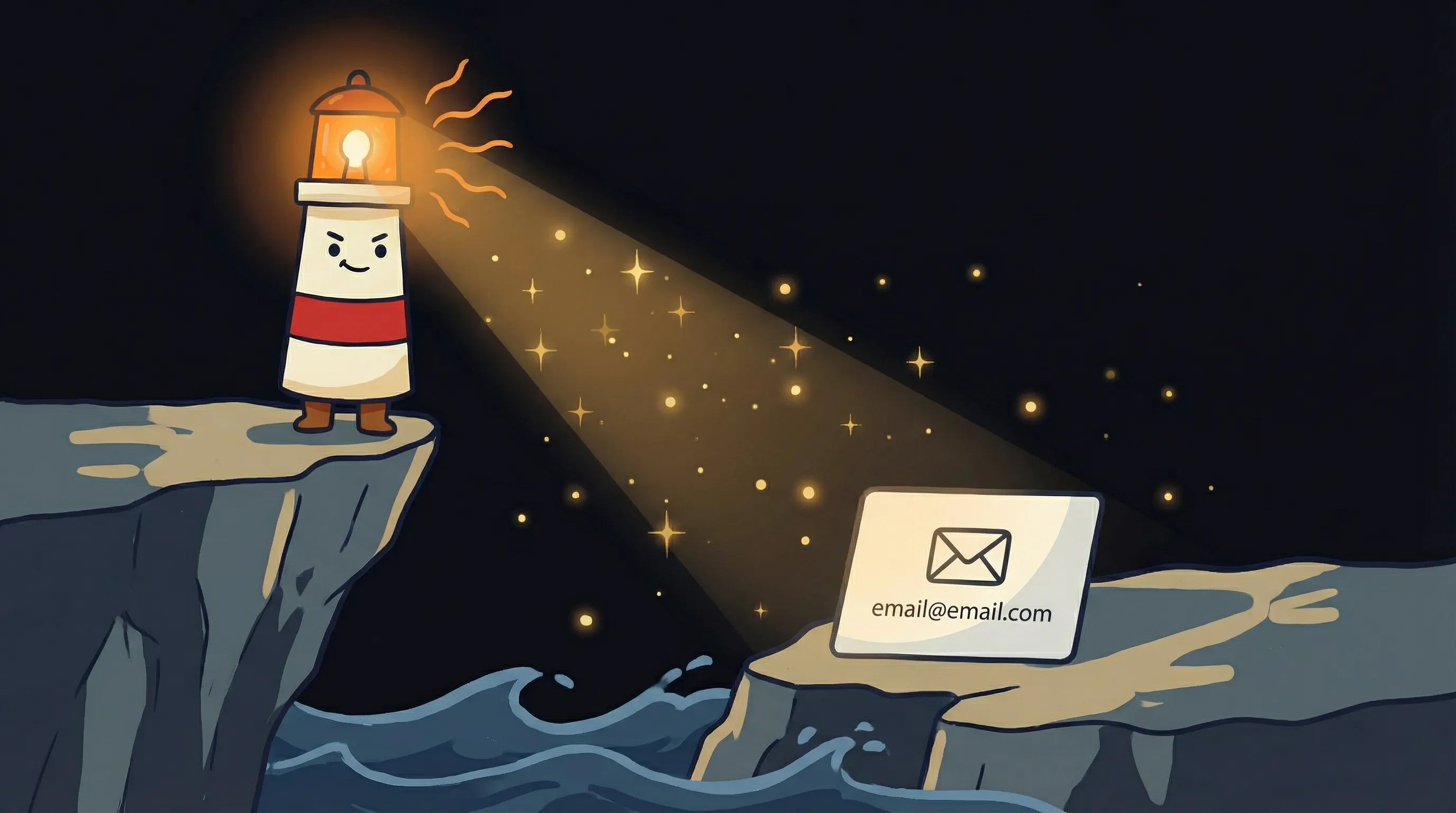 Some relationships don’t need managing — they need remembering. Beacon’s shining a light on the inbox you already have.
- Test it manually before trusting the cron. Ask your agent in the personal-crm topic: ‘What do I know about [your own email address]?’ If it returns a record, the database connection is working. If you get nothing, check that the
gogskill has the correct permissions. - Let it run for 48 hours before judging it. The first morning briefing may be sparse — there’s only 24 hours of history. By day three, the database has enough history to surface useful context.
If you want to see more examples of what agents built this way can do, How People Actually Use Personal AI Agents in 2026 covers a dozen real workflows with similar architecture.
Where This Setup Breaks Down
It’s Monday morning. You walk into a meeting with someone your agent has never seen before — a referral who emailed you once, six months ago, from a different address than the one they use now. The briefing is blank. This happens.
- Multiple email addresses per person confuse the deduplication. If someone emails you from their work address and their personal address, the agent may create two records. You’ll need to merge them manually or extend the schema with a
canonical_emailfield over time. - The notes field is only as good as the email subjects and meeting titles. If your meetings are called ‘Catch-up’ and your emails say ‘Following up,’ the context the agent captures will be thin. Descriptive meeting titles and email subjects dramatically improve briefing quality.
- Gmail permission scope matters. The
gogskill needs read access to both Gmail and Calendar. If you’ve restricted OAuth scopes, the 6 AM scan will fail silently — you won’t know until you notice the database isn’t updating. - The system doesn’t know what you talked about on a phone call. It only reads what’s in your email and calendar. Calls, Slack DMs, in-person conversations — those don’t get captured unless you manually add a note after the fact.
- High-volume inboxes can create noise. If you’re on hundreds of mailing lists, the contact discovery job will pick up newsletter senders as ‘contacts.’ Add a filter rule early: exclude domains like newsletters., substack.com, and no-reply@ from contact extraction.
Signs Your AI Personal CRM Is Actually Working
After 48-72 hours, run these checks before assuming everything’s healthy.
- Query a contact you’ve emailed in the last week. Ask in Telegram: ‘What do I know about [Name]?’ You should get back their email, interaction count, last contact date, and any notes extracted from recent threads.
- Check the morning briefing format. Open your Telegram personal-crm topic the morning after setup. If you had meetings that day, you should see a briefing per external attendee. If the topic is empty, the 7 AM cron isn’t firing — check your OpenClaw task scheduler.
- Verify new contacts are being discovered. After a day where you emailed someone new, query their name. They should exist in the database. If not, the
gogGmail scan permissions may be scoped too narrowly. - Test a follow-up query. Ask: ‘Who needs follow-up?’ The agent should return contacts where
last_contactis more than 2-3 weeks ago, ranked by interaction count. If it returns nothing or returns everyone, the query logic needs tuning. - Look for duplicate records. Search for a contact you know has emailed you from two addresses. If you see two records, note the pattern — you’ll want to set up a deduplication rule before the database gets large.
Your Monday Morning CRM Setup Checklist
Forty-five minutes. That’s all this takes if you have an OpenClaw instance running. Here’s the exact sequence:
- Create the SQLite database file using the 6-field schema above. Name it
crm.dband put it somewhere your agent can reach — a local path on your server or the default data directory in your OpenClaw instance. - Install the
gogCLI skill from ClawhHub if it’s not already installed. Authorize it with your Google account. Confirm both Gmail and Google Calendar scopes are enabled — if either is missing, the cron will run but capture nothing. - Create the
personal-crmTelegram topic in your agent’s group. If you don’t have a BrainRoad agent yet, this is the point where you set one up at brainroad.com — the wizard handles the Telegram connection. - Paste the full prompt above into your agent task in OpenClaw. Set the 6 AM cron and the 7 AM briefing as two separate scheduled tasks, or as a single task with two time triggers. Either works.
- If your inbox volume is over 50 emails per day, add an exclusion filter immediately: block no-reply@, newsletters.*, and any domain patterns for mailing lists you’re on. Do this before the first scan runs, not after.
- Run a manual test query: message your personal-crm topic with ‘What do I know about [your own name]?’ If your agent returns a record with your email and a first_seen date of today, the pipeline is working end to end.
- Budget roughly $20/month for API usage at normal professional email volume — more if you’re processing hundreds of threads daily. Check your usage dashboard after the first 72 hours to confirm you’re in range.
What This Means for How You Work
- An AI personal CRM that reads your email automatically captures relationship data you’d never enter manually — which is why manual systems fail within weeks while this one improves daily.
- The 6-field schema (name, email, first_seen, last_contact, interaction_count, notes) is minimal by design. Software that maintains six fields reliably is more useful than software that asks you to maintain twenty.
- The 7 AM briefing is the highest-ROI part of the workflow. Walking into a meeting knowing exactly when you last spoke and what was discussed changes the quality of every conversation.
- Natural language queries — ‘Who needs follow-up?’ ‘What do I know about Marcus?’ — make the database accessible without learning SQL or opening any app.
- Start with email and calendar. Once the baseline is running, you can extend it to surface profile updates and social signals as outreach triggers — but get the foundation right first.
Frequently Asked Questions
Do I need to know how to code to set this up?
Not really. The SQL schema is a copy-paste operation — you’re not writing logic, just creating a table structure. The OpenClaw prompt is plain English. The trickiest part is authorizing the Google OAuth connection for Gmail and Calendar, and that’s a standard web flow. If you’ve ever connected an app to your Google account, you’ve done harder things.
What if someone emails me from multiple addresses?
The current schema creates separate records per email address. If someone regularly uses two addresses, you’ll end up with two contacts for the same person. The fix is to manually merge them and set a canonical email in the notes field, or extend the schema with a canonical_email column over time. It’s the most common gotcha in the first week.
Does the AI personal CRM capture phone calls or Slack messages?
No. It only reads Gmail and Google Calendar. Phone calls, Slack DMs, and in-person conversations don’t appear in those sources. You can add context manually by messaging your personal-crm Telegram topic: ‘Note for Marcus Chen — called today, moving to a new role in March.’ The agent will log it.
How much does it actually cost per month?
The core setup runs around $20/month at normal professional email volume. That covers API usage for the daily scans and briefings. SQLite has no hosting cost. If your inbox processes hundreds of threads daily, usage could run higher — check your OpenClaw dashboard after the first 72 hours to calibrate.
Can I query the CRM from anywhere, or only from Telegram?
The default interface in this setup is Telegram. But OpenClaw can route to WhatsApp, Signal, or iMessage if you prefer. The query prompt works the same way regardless of which messaging app you connect — you ask in plain language, the agent searches the database and responds.
Sources
- OpenClaw Personal CRM Use Case (GitHub)
- Everyone Can Have Their Own AI CRM — Growth Unhinged
- Best Personal CRM Software 2025 — Orvo
- Top 10 Best Personal CRM Apps — Dex
- Personal CRM Software: 10 Best Solutions — Monday.com
- Best AI-Powered Personal CRM 2025 — Medium
- How I Built a Personal CRM With AI and No-Code Tools — LinkedIn