AI Agent vs Chatbot: Why ChatGPT Isn't an Agent
On this page
I’ve had this conversation at least fifty times in the past year. Someone tells me they ‘built an AI agent’ and when I ask what it does, they describe a ChatGPT wrapper with a custom system prompt.
That’s not an agent. That’s a chatbot with a personality.
The confusion is everywhere right now. The AI agent vs chatbot distinction matters because companies are making six-figure hiring decisions based on it. Job postings ask for ‘AI agent experience’ when they mean ‘can use ChatGPT.’ Developers claim agent expertise because they’ve called the OpenAI API. And businesses buy ‘AI agent platforms’ that are really just fancy chat interfaces.
The agentic AI market is projected to grow from $5.2 billion in 2024 to $200 billion by 2034. That’s a 40x increase in ten years. But most of what’s being sold as ‘agents’ today wouldn’t qualify under any technical definition. In a minute, I’ll show you exactly where ChatGPT falls short—and it’s not where you’d expect.
What Makes Something an AI Agent?
An AI agent is an autonomous system that can plan, reason, and execute multi-step workflows on its own. You give it a goal. It figures out how to accomplish that goal. It uses tools. It handles obstacles. It keeps working when you’re asleep.
That last part is the key. A chatbot waits for your next message. An agent keeps going.
The Autonomy Factor
Traditional chatbots rely on decision trees—structured ‘if/then’ pathways that only respond within predefined parameters. When a customer asks something unexpected, the bot stalls or escalates to a human.
AI agents work differently. They dynamically direct their own processes and tool usage, maintaining control over how they accomplish tasks. They’re not following a script. They’re pursuing a goal.
That said, today’s agents are semi-autonomous, not fully autonomous. They ask for human input when they don’t have enough information. The marketing says ‘autonomous AI,’ but the reality is closer to ‘AI that can work unsupervised for longer stretches.‘
Tool Integration
AI agents integrate with external, API-driven tools and systems to automate tasks and retrieve or modify information across your enterprise systems. They can:
- Check your calendar and schedule meetings
- Search your documents and draft responses
- Update your CRM based on conversation outcomes
- Send emails on your behalf
- Process payments and update records
A chatbot can tell you about these things. An agent does them.
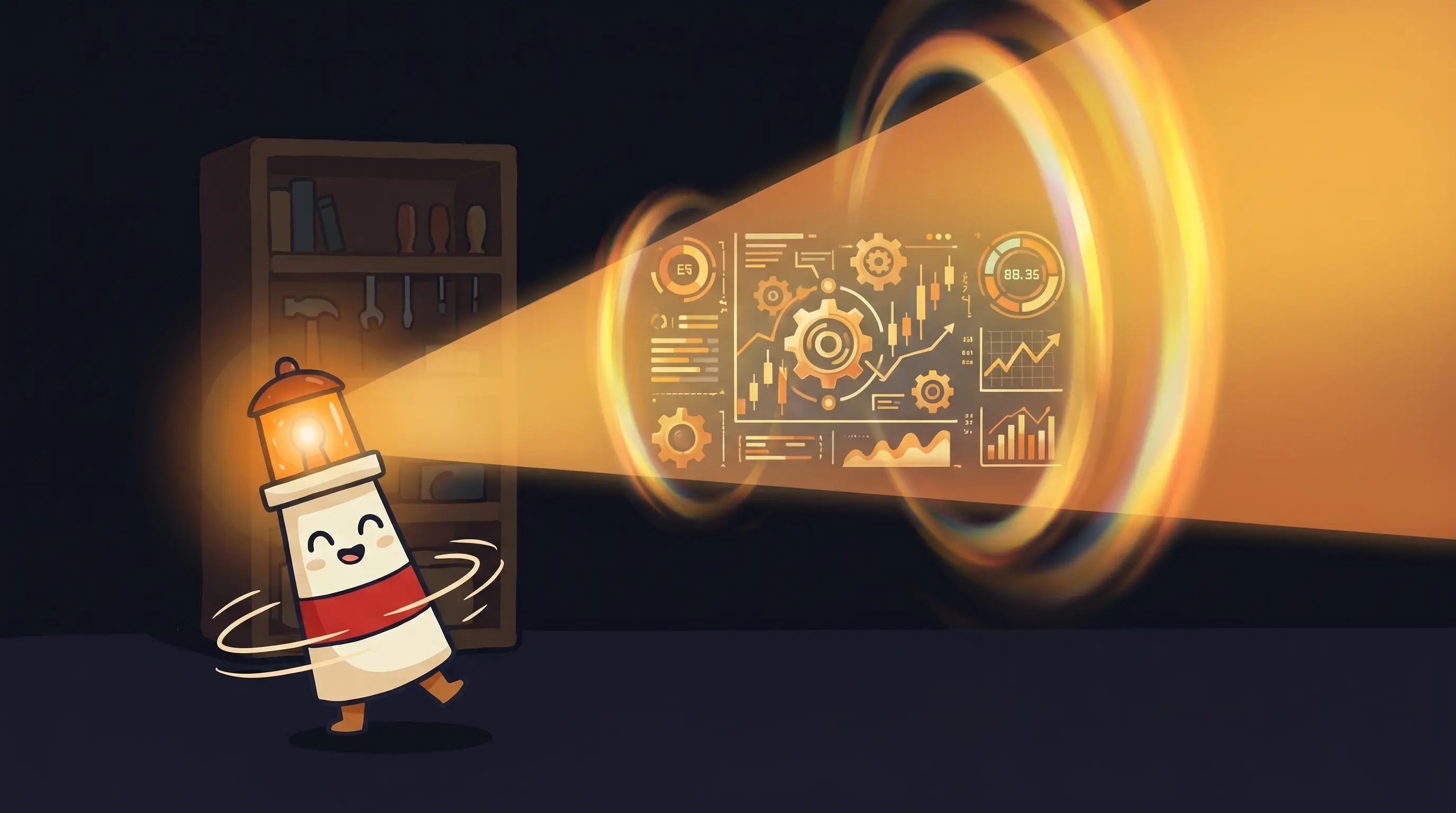
 Beacon says: a flashlight and a lighthouse both shine light, but only one can guide ships safely home.
Goal-Oriented Execution
Here’s the clearest test: Can it work toward a goal you set yesterday?
If you tell a chatbot ‘help me get more sales meetings,’ it might give you advice. Then the conversation ends.
If you tell an agent the same thing, it might research prospects, draft personalized outreach, send the emails, follow up with non-responders three days later, and book meetings directly into your calendar. All while you’re doing something else.
Why ChatGPT Falls Short of True Agency
ChatGPT is remarkable. GPT-4 can reason through complex problems, write sophisticated code, and hold nuanced conversations. But it’s fundamentally a prompt-and-response system.
Here’s what happens when you close the ChatGPT tab:
Nothing.
ChatGPT doesn’t continue working. It doesn’t check back on tasks. It doesn’t notice when something changes and adapt. It sits there waiting for your next prompt.
Even with plugins and the new GPT features, ChatGPT is reactive. It responds to what you ask. It doesn’t initiate. It doesn’t persist. It doesn’t pursue goals over time.
The plugins help with tool access—ChatGPT can browse the web, run code, analyze files. But it still only does these things when you ask, one request at a time. That’s not agency. That’s a very smart assistant who only works when you’re standing there giving instructions.
The Part Most People Get Wrong About AI Agents
Here’s the counterintuitive insight I promised: the intelligence isn’t what separates agents from chatbots.
ChatGPT, Claude, Gemini—these are extraordinarily capable systems. They can reason, plan, and solve problems better than most human experts in many domains. The underlying model in a sophisticated AI agent might be the exact same GPT-4 or Claude that powers a chatbot.
What separates them is the architecture around the model.
An AI agent wraps a language model in a persistent execution loop. It adds memory that persists across sessions. It adds tool integrations that let it take real actions. It adds goal-tracking that keeps it oriented toward outcomes. It adds scheduling that lets it work when you’re not there.
The model provides the intelligence. The agent architecture provides the autonomy.
This is why adding ‘AI agent’ to a resume doesn’t mean building something with ChatGPT. Building chatbots and building agents require completely different skills. One is about prompt engineering and conversation design. The other is about orchestration, state management, and tool integration.
Where Each Approach Actually Works
This isn’t about agents being ‘better’ than chatbots. They’re different tools for different problems.
When Chatbots Win
Chatbots excel at interactive, conversational experiences where a human is actively engaged:
- Customer support Q&A (human is present, asking follow-ups)
- Interactive product recommendations
- Guided troubleshooting workflows
- Learning and tutoring sessions
- Brainstorming and ideation
- Content editing with real-time feedback
If the value is in the conversation itself—the back-and-forth, the exploration, the human judgment—a chatbot is the right tool.
When You Need an Agent
Agents shine when you need outcomes, not conversations:
- Monitoring inboxes and responding to routine emails
- Scheduling across multiple calendars
- Research that requires checking multiple sources over time
- Follow-up sequences that run over days or weeks
- Data processing that happens on a schedule
- Proactive alerts when conditions change
If you find yourself thinking ‘I wish this would just handle itself,’ that’s an agent use case.
Most businesses will benefit from both. The global AI agents market is projected to reach $7.6 billion in 2025, up from $5.4 billion in 2024—but that doesn’t mean chatbots are going away. They serve different purposes.
The Tradeoffs Nobody Mentions
Agents come with costs that the marketing glosses over:
- Higher API costs — An agent that works continuously burns through API calls. A chatbot only costs money when humans are chatting. An agent researching prospects at 3 AM adds up fast.
- More failure modes — Every tool integration is a potential breaking point. Your agent works great until your calendar API changes or your email service rate-limits you.
- Trust requirements — Giving an agent access to your email, calendar, and CRM means trusting it with sensitive actions. A chatbot that gives bad advice is annoying. An agent that sends bad emails to your clients is expensive.
- Harder to debug — When a chatbot gives a weird response, you can see the conversation. When an agent does something unexpected, you’re often tracing through logs of tool calls, state changes, and decision points.
- Setup complexity — Chatbots can be deployed in an afternoon. Agents require configuring tools, permissions, guardrails, and monitoring. The ‘no-code agent builders’ hide this complexity but don’t eliminate it.
How to Know Which You Actually Need
Ask yourself these questions:
- Do I need this to work when I’m not there? If yes, agent. If no, chatbot.
- Is the value in the conversation or the outcome? Conversation = chatbot. Outcome = agent.
- Am I willing to give this system access to take real actions? If you’re not ready to let AI send emails, book meetings, or update records on your behalf, you’re not ready for an agent.
- Can I clearly define the goal? Agents need objectives. If your need is exploratory or the goal keeps shifting, a chatbot’s interactive nature might serve you better.
- Do I have the systems in place? Agents need tools to use. If your processes aren’t already API-accessible or digitized, an agent has nothing to plug into.
The honest answer for most people in 2026: you probably want a personal AI assistant that can do both—chat when you need to brainstorm, act autonomously when you need things done.
Your Monday Morning Decision Framework
Here’s how to evaluate whether you need a chatbot, an agent, or both:
- Audit your repetitive tasks this week. Write down everything you do repeatedly that follows a pattern. Email follow-ups, scheduling, research, data entry. These are agent candidates.
- Identify your conversation-heavy interactions. Customer questions, brainstorming sessions, content creation. These stay as chatbot use cases.
- Check your integration readiness. For each agent candidate, ask: Is this system accessible via API? Do I have the credentials? Can I grant permission safely? If the answer is no to any, start there.
- Start with one contained use case. Pick the simplest repetitive task with clear success criteria. Don’t try to build a general-purpose agent that does everything.
- Budget $50-150/month initially. That covers API costs for moderate agent usage. If you’re burning more than $200/month in the first 90 days, you’ve probably scoped too big.
- Set up monitoring before you launch. You need to see what the agent is doing. Most AI agent platforms include logs and activity feeds. Use them.
- If you’re not ready for full autonomy, start with a chatbot that surfaces information and recommendations. Graduate to agent actions once you trust the system.
What This Means for Your AI Strategy
- ChatGPT is a chatbot, not an agent. It’s one of the smartest chatbots ever built, but it still waits for your prompts and stops when you stop.
- The difference is autonomy, not intelligence. Agents use the same underlying models but wrap them in persistent execution loops, tool integrations, and goal-tracking.
- Most ‘AI agents’ being sold today aren’t agents. If it only works when you’re actively using it, it’s a chatbot with better marketing.
- You probably need both. Chatbots for interactive work, agents for outcomes that should happen without you.
- The global AI agents market will reach $7.6 billion in 2025. Real demand exists—but make sure you’re buying what you actually need.
Common Questions About AI Agents vs Chatbots
Can ChatGPT be turned into an AI agent?
Yes, but not by itself. You’d need to wrap ChatGPT’s API in an agent framework—something that handles persistent memory, tool integrations, scheduling, and goal-tracking. Services like BrainRoad do this for you, giving you an agent powered by models like GPT-4 or Claude that actually works autonomously.
Are AI agents more expensive than chatbots?
Usually, yes. Chatbots only cost money during active conversations. Agents work continuously—researching, monitoring, following up—which means more API calls. Budget $50-150/month for a useful personal agent versus $20/month for ChatGPT Plus.
Is Claude an AI agent or a chatbot?
Claude, like ChatGPT, is a chatbot. It’s a brilliant conversational AI, but it responds to prompts and stops when you stop. Claude can be the underlying model for an agent, but the product you access at claude.ai is a chatbot interface.
What's the biggest risk with AI agents?
Unsupervised actions on real systems. An agent that can send emails, book meetings, or update your CRM can also send wrong emails, double-book you, or corrupt your data. Start with limited permissions, monitor closely, and expand autonomy gradually as you build trust.
Do I need technical skills to use an AI agent?
Not anymore. Early agents required coding to set up. Modern agent platforms offer guided setup wizards, pre-built templates, and no-code configuration. If you can follow a setup guide, you can deploy a personal agent.