Agentic AI vs Generative AI: What's the Difference?

On this page
I’ve watched this confusion burn people for three years now. Someone signs up for Claude Pro, gets genuinely excited about the output quality, then hits a wall when they realize it won’t actually DO anything after generating the content. It just sits there, waiting for the next prompt.
The frustration is real. You’ve got this incredibly capable AI that writes better emails than most people, but it can’t send them. Can’t schedule the follow-up. Can’t check if the recipient responded and adjust accordingly. The gap between what generative AI produces and what gets done in the real world — that gap is exactly where agentic AI lives.
The terminology makes it worse. Marketing teams slap “AI agent” on everything now. But there’s a real, practical difference between these two approaches, and understanding it determines whether you’ll spend months fighting with tools that don’t fit your workflow or deploy something that genuinely works while you sleep. I’ll show you the actual dividing line in a minute — but first, why this split happened at all.
How AI Evolved from Calculators to Collaborators
The progression matters for understanding what you’re actually deploying when someone sells you “AI.” We’ve been through four distinct waves, and each one increased AI’s capacity to operate independently.
Rule-based systems came first — think tax software or basic chatbots with decision trees. If X, then Y. No learning, no adaptation. Machine learning added pattern recognition: the system could look at data and improve its predictions over time. Still reactive, still narrow.
Then came generative AI. ChatGPT’s public release in late 2022 marked the moment most people realized AI could create genuinely useful content — not just classify things or make predictions, but synthesize new text, images, code. The models learned patterns from massive datasets and could generate outputs that felt creative.
But generative AI, even at its most impressive, remains reactive by design. It generates outputs and waits for instructions. It stops short of driving outcomes. That’s the ceiling — and it’s where agentic AI picks up.
What Generative AI Does (And Where It Stops)
Generative AI creates content by learning from data and generating outputs based on learned patterns. Models like Claude 3.5 Sonnet and GPT-4o handle text. Diffusion models handle images. The underlying mechanism is the same: pattern recognition applied to creation rather than classification.
The sweet spot is on-demand content creation. Need a blog post draft? Marketing copy? Code snippet? Image concept? Generative AI excels here. It’s an extraordinary tool for exploration and ideation — I use it daily.
But it requires you to be present for each request. You prompt, it responds, you evaluate, you prompt again. There’s no continuity between sessions unless you explicitly provide it. The AI doesn’t remember what it did for you yesterday unless you tell it.
- Writes email drafts but doesn’t send them
- Generates reports but doesn’t update them when data changes
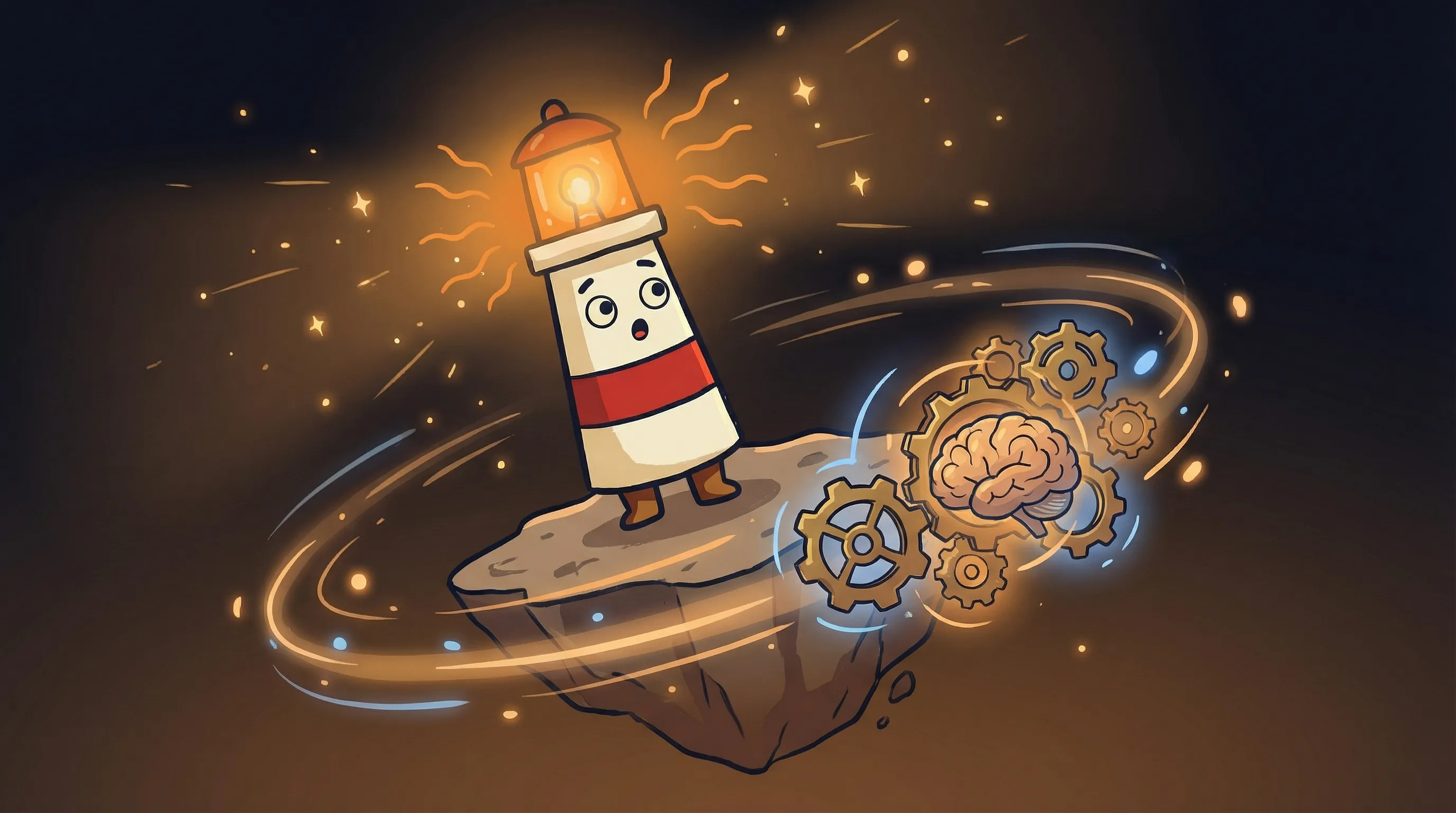 Beacon says: one AI creates, the other acts — knowing the difference changes everything.
- Creates meeting agendas but doesn’t schedule the meetings
- Suggests follow-up actions but doesn’t execute them
The pattern is consistent: generative AI is your brainstorming partner, not your operator. It handles creation. Execution remains your job.
What Agentic AI Does Differently
Agentic AI is software that can independently make decisions and carry out tasks to achieve a specific objective. Rather than following rigid, pre-programmed rules, it can map out and complete a sequence of actions on its own.
The key difference: agentic AI is focused on decisions and execution rather than content creation, and doesn’t solely rely on human prompts nor require human oversight for every step. It uses large language models, tool integrations, and natural language processing to perform autonomous tasks on behalf of the user.
Early-stage examples include virtual assistants and copilots with task-oriented goals. More recent examples include OpenAI’s Operator, Google’s Project Mariner, and personal AI agent platforms like BrainRoad — systems designed to automate complex workflows, not just answer questions.
- Monitors your inbox and responds to routine inquiries without asking
- Schedules meetings by checking all parties’ calendars and finding optimal times
- Tracks project deadlines and proactively flags risks before they become problems
- Executes multi-step processes: research, draft, send, follow up, adjust based on response
- Messages you on WhatsApp or Signal when something needs your attention
The main thing to know: generative AI is reactive and agentic AI is proactive. One waits for your prompt. The other pursues your goals.
The Part Most Explanations Skip: Why Agentic AI Needs Generative AI
Here’s what the marketing materials leave out: agentic AI doesn’t replace generative AI. It builds on top of it.
When an agentic system needs to draft an email, it uses generative capabilities. When it needs to understand a customer’s message, it uses natural language processing trained the same way. The “agent” part is the orchestration layer — the planning, decision-making, and execution logic that sits above the generative foundation.
Think of it like a building. Generative AI is the engine. Agentic AI is the vehicle. The engine produces power (content, analysis, reasoning). The vehicle channels that power toward a destination (completed tasks, handled workflows, achieved outcomes). You need both.
The agentic layer handles the “what should I do next?” question. Generative AI handles the “how do I create this specific output?” question. Both are necessary for a system that actually gets work done without you babysitting it.
When to Use Which: A Decision Framework
The guidance from practitioners is straightforward: use generative AI for ideas and drafts, and agentic AI for planning, coordination, and follow-through.
But that’s abstract. Here’s how I actually decide:
- Does the task end with creation, or require execution? If you need a document written, generative AI is sufficient. If that document needs to be sent, tracked, and followed up on, you need agentic capabilities.
- How many steps are involved? Single-step tasks (write this, summarize that) work fine with generative AI. Multi-step workflows with dependencies between steps need an agent to orchestrate.
- Does the outcome depend on external systems? Generative AI can’t access your calendar, CRM, or email. Agentic AI can — and can take actions within those systems.
- How much oversight can you provide? Generative AI requires you to evaluate and act on every output. If you need 24/7 operation or faster response times than you can personally provide, agentic AI handles the gap.
- Is anyone else waiting on the output? If a client emails at 2 AM expecting a response, generative AI won’t help. An agent monitoring your inbox will respond within minutes.
Most people start with generative AI because the entry point is simpler — sign up for ChatGPT and start prompting. Agentic AI demands more setup and monitoring, but handles complex workflows independently once configured. In my experience, the people who get the most leverage are running both: generative AI for on-demand thinking, agents for autonomous execution.
Where Both Types Fall Short
After watching dozens of deployments, the failure patterns are predictable.
Generative AI’s limits are well-documented by now. It hallucinates — makes up information that sounds plausible but isn’t real. It lacks persistence; every session starts fresh unless you engineer around it. It can’t take action in the real world.
Agentic AI has its own failure modes:
- Generative AI hallucinates facts confidently — always verify critical information
- Agentic AI can make poor autonomous decisions — unclear goals lead to wasted effort or worse
- Both require careful prompt design; garbage instructions produce garbage results
- Neither truly “understands” context the way humans do — they pattern-match at scale
- Agentic systems interacting with critical systems can cause real damage if guardrails fail
The harder questions are around autonomy boundaries. Can the agent safely make this decision? What happens when it’s wrong? How fast can you roll back? These aren’t theoretical concerns — they’re the difference between AI automation that helps and automation that creates expensive messes.
How to Tell If You Need Agentic AI
Not everyone does. If your work involves discrete creative tasks with clear start and end points, generative AI might be all you need. But consider agentic AI if:
- You’re doing the same multi-step process repeatedly (follow-up sequences, report generation, data gathering)
- Response time matters more than you can personally deliver (inquiries arriving at 2 AM)
- You’re already spending significant time just orchestrating AI outputs (copying results between tools, tracking what’s been done)
- You need proactive monitoring rather than reactive responses (flagging issues before they escalate)
The test I use: if you’re babysitting AI outputs instead of doing higher-value work, you’ve outgrown generative AI alone. The orchestration burden is the signal.
The landscape has matured enough that you no longer need to self-host complex infrastructure. Managed AI agent platforms handle the orchestration layer, letting you focus on defining what you want accomplished rather than building the execution machinery. BrainRoad, for example, gives you a personal AI agent running 24/7 in an isolated container — connected to your email, calendar, and messaging apps — without touching a terminal.
Your First Week: A Practical Starting Point
Whether you’re just getting started or ready to move from generative to agentic AI, here’s a concrete plan:
- Audit your repetitive tasks this week. Write down every multi-step process you do more than twice. Note which steps involve creation (generative) vs. action (agentic).
- Pick one workflow with 3-5 steps that currently requires you to manually move between tools.
- If it’s purely content creation, try a generative AI tool first. Budget $20/month for ChatGPT Plus or Claude Pro.
- If the workflow involves sending, scheduling, or updating external systems, you need an agentic solution. Look at platforms that connect to your existing tools — calendar, email, CRM, messaging.
- Start with guardrails. Any agentic system should have human approval for high-stakes actions. No autonomous decisions on anything irreversible until you trust it. Most platforms let you run in “shadow mode” first.
- Track time saved over 30 days. If you’re saving less than 2 hours per week, either the workflow was wrong or the tool is wrong.
The goal isn’t to automate everything immediately. It’s to identify where automation actually creates value versus where it creates maintenance burden. Most people overestimate generative AI’s usefulness and underestimate the setup cost for agentic AI. Both calibrations happen through experience.
Common Questions About Agentic AI vs Generative AI
Can I use both agentic and generative AI together?
Yes — and most sophisticated implementations do. Agentic AI systems typically use generative AI for content creation tasks within larger automated workflows. Think of agentic AI as the project manager that decides what needs doing, and generative AI as the specialist that creates specific outputs. Many enterprises now deploy both types together, using generative capabilities within autonomous agent systems.
Is ChatGPT generative or agentic AI?
ChatGPT is primarily generative AI — it creates content in response to prompts. However, OpenAI has been adding agentic features through plugins, Code Interpreter, and tools like Operator. The base model generates text; the additional capabilities move toward agentic behavior by allowing the AI to take actions and use external tools.
Do I need technical skills to use agentic AI?
It depends on the platform. Self-hosted solutions require significant technical knowledge. Managed agentic AI platforms have reduced this barrier considerably — some now offer GUI onboarding and pre-built agent templates that let you deploy working agents without writing code. The setup is more involved than signing up for ChatGPT, but not prohibitively so.
What are the risks of agentic AI making decisions autonomously?
The primary risks are unauthorized actions, poor decisions from ambiguous goals, and cascade failures when agents interact with critical systems. Mitigation requires clear guardrails: approval thresholds for significant actions, monitoring systems, rollback capabilities, and well-defined scopes. Never give an agent unlimited access to systems that handle money, customer data, or irreversible operations without human checkpoints.
How much does agentic AI cost compared to generative AI?
Generative AI typically runs $20-100/month for individual plans. Agentic AI platforms vary more widely — some start free with usage-based pricing, while enterprise solutions can run thousands monthly. The total cost also depends on API usage (agentic systems often make many more API calls than simple chat interfaces) and integration complexity. Budget 2-5x more for agentic AI in the early stages until you optimize the workflows.
Related BrainRoad guides
Sources
- Zendesk - Agentic AI vs. Generative AI
- Salesforce - Agentic AI vs Generative AI
- IBM - Agentic AI vs. Generative AI
- Thomson Reuters - Agentic AI vs Generative AI
- NWAI - Complete Guide
- Exabeam - 5 Key Differences
- VAST Data - Understanding the Next Leap Forward
- Grammarly - Key Differences Explained
- Techment - Enterprise Guide