Agentic AI Frameworks Compared (2026)
On this page
The Framework Question Nobody Asks Until It’s Too Late
I’ve been watching teams pick AI agent frameworks the same way they pick JavaScript libraries—whatever has the most GitHub stars this week. That approach works fine for a todo app. It doesn’t work when you’re building software that makes autonomous decisions about customer data at 3 AM.
The framework you choose determines failure modes you won’t see until production. I learned this the expensive way. A team I advised spent six weeks building on a framework that looked perfect in demos. Two months post-launch, they discovered it couldn’t handle the state management their workflow actually required. The rebuild cost them a quarter.
Here’s what I’ve noticed after watching dozens of these deployments: the gap between ‘works in development’ and ‘works in production’ is almost entirely about framework choice. The LLM calls work the same everywhere. The retry logic, memory persistence, and multi-agent coordination? That’s where teams either sail through or spend months firefighting.
What AI Agent Frameworks Actually Do
An agentic AI framework sits between you and the raw LLM APIs. Without one, you’re writing the same infrastructure code that every other team writes—badly, at first, because you don’t know the edge cases yet.
The critical infrastructure these frameworks handle:
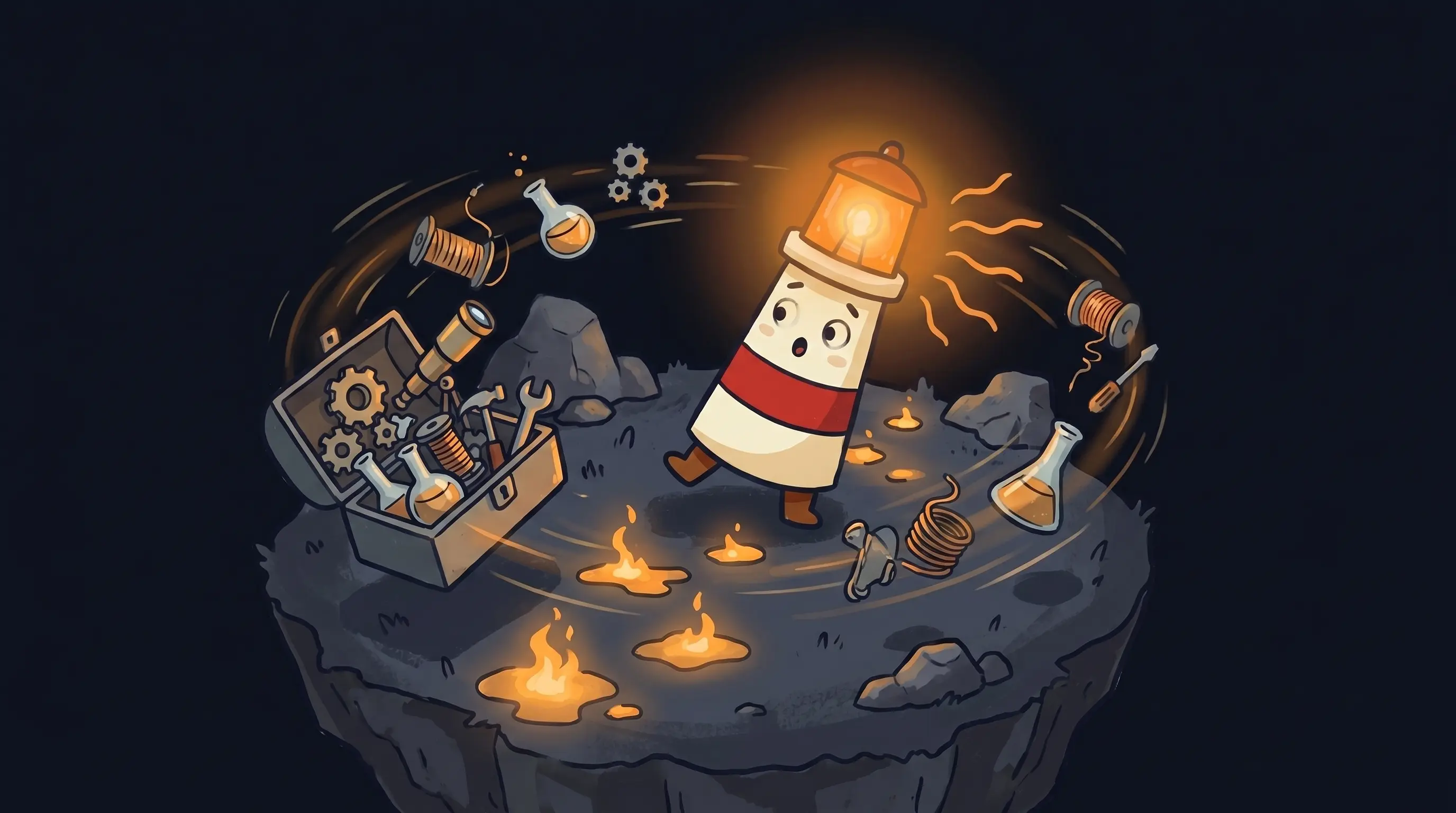
 Beacon says: with so many frameworks out there, it helps to have a guide who’s compared them all.
- Memory management so your agent doesn’t forget what it’s doing mid-task
- Parsing unpredictable LLM outputs into structured data your code can use
- Retry logic for the inevitable API failures (and there will be many)
- Secure connections to external tools and data sources
- State persistence so crashed agents can resume where they left off
- Orchestration between multiple agents when one isn’t enough
Most modern AI agent frameworks rely on the ReAct pattern—a loop where the agent reasons about what to do, takes an action, observes the result, and repeats. The pattern itself is straightforward. The framework’s job is making that loop reliable at scale.
The 5 AI Agent Frameworks Worth Your Time in 2026
LangChain/LangGraph
LangGraph models your agent as a state graph—nodes for actions, edges for transitions. Sounds academic until you’re debugging why your agent went from ‘send email’ to ‘delete database’ with no explanation. The graph structure makes that path visible.
According to AWS’s framework comparison, LangChain/LangGraph has the strongest ratings across the board: autonomous workflow complexity, multimodal capabilities, foundation model selection, and LLM API integration. It’s also the steepest learning curve in the group.
AutoGen
AutoGen shines when you need multiple agents collaborating autonomously—think a researcher agent, a writer agent, and an editor agent working together without constant human intervention. AWS rates it strong for autonomous multi-agent support and workflow complexity.
The tradeoff: weak AWS integration and a steep learning curve. If you’re building on AWS infrastructure, you’ll be writing glue code. If you’re elsewhere, that weakness doesn’t matter.
CrewAI
CrewAI takes the opposite approach from LangGraph’s explicit state management. You define agents with roles and goals, then let the framework figure out the coordination. The learning curve is moderate instead of steep.
The cost is capability: weak multimodal support and weak AWS integration. If your agents need to process images, audio, or video alongside text, CrewAI isn’t the right foundation.
Strands Agents
If you’re building on AWS, Strands Agents deserves serious consideration. It has the strongest AWS integration of any framework in the comparison—native connections to Bedrock, Lambda, and the rest of the AWS ecosystem.
The framework is DIY on hosting (you’re responsible for deployment infrastructure), but the moderate learning curve and strong capabilities across workflow complexity and LLM integration make it competitive with LangGraph for AWS-native teams.
The Hybrid Approach
AWS’s guidance explicitly recommends what I’ve seen work in practice: many organizations benefit from a hybrid approach, using multiple frameworks for different components of their AI ecosystem. LangGraph for complex orchestration, CrewAI for rapid multi-agent prototyping, Strands for AWS-native services.
Why Single-Agent Systems Fall Apart at Scale
Here’s the counterintuitive truth that took me too long to learn: single-agent systems degrade as responsibilities grow. You can’t keep adding tools and capabilities to one agent forever. Eventually, the context window fills up, the decision space gets too complex, and reliability craters.
Multi-agent frameworks solve this through specialization. One agent handles research. Another handles writing. A third handles quality review. Each agent has a narrow focus and a manageable context. The framework coordinates communication between them.
The research confirms what production experience shows: composing multiple agents into a multi-agent system offers significant advantages—enhanced modularity, specialization, reusability, maintainability, and structured control flows. You’re not fighting the architecture; you’re working with it.
The AI Agent Framework Selection Matrix
AWS’s framework comparison gives you the raw data. Here’s how to read it for your situation:
- AWS-native deployment? Strands Agents first, LangGraph second
- Complex multi-step workflows? LangGraph for visibility, AutoGen for autonomy
- Rapid prototyping? CrewAI’s moderate learning curve gets you there faster
- Multimodal processing? LangGraph (strongest) or Strands (strong)
- Team with limited ML expertise? CrewAI’s role-based abstraction hides complexity
When selecting an agentic AI framework, consider not only technical capabilities but organizational fit—team expertise, existing infrastructure, and long-term maintenance requirements. The framework that matches your team’s skills beats the framework with the best benchmarks every time.
Where Framework Decisions Go Wrong
Friday afternoon. Your agent has been working fine for weeks. Then a user triggers an edge case that sends the agent into an infinite retry loop. By Monday morning, you’ve burned through $2,000 in API calls and the agent has sent 47 duplicate emails to a customer.
This happens because teams underestimate what ‘reliable agent frameworks must provide.’ The requirements list is longer than most teams realize:
- Strong orchestration (routing decisions to the right agent)
- Error recovery (graceful handling when things break)
- State management (knowing where you are in a workflow)
- Safety guardrails (preventing runaway loops and dangerous actions)
- Testing support (validating behavior before production)
- Observability (understanding what happened when something goes wrong)
If your chosen framework is weak on any of these, you’ll be writing that infrastructure yourself. That’s months of work that doesn’t differentiate your product.
Your Monday Morning Framework Evaluation
- Audit your current agent architecture. If you’re using a single agent with more than 8 tools, you’re probably past the complexity threshold where multi-agent would help.
- Map your deployment target. AWS-native? Strands Agents. Multi-cloud or self-hosted? LangGraph or AutoGen.
- Assess your team’s learning capacity. A steep-learning-curve framework (LangGraph, AutoGen) requires 2-4 weeks of focused learning. Moderate (CrewAI, Strands) requires 1-2 weeks.
- If you’re starting fresh, prototype with CrewAI first. It’s the fastest path to a working multi-agent system. You can migrate to LangGraph later if you need the state visibility.
- Budget $50-150/month for API costs during development and testing. Real agent workflows consume more tokens than chatbot interactions.
- Set up observability from day one. You need logs showing agent decision paths before you have a production incident, not after.
What This Means for Your Agent Strategy
- Agentic AI frameworks handle the infrastructure you don’t want to build—memory, parsing, retries, state, and coordination. Choose wrong and you’ll rebuild it yourself.
- LangGraph leads for complex workflows and debugging visibility. AutoGen excels at autonomous multi-agent collaboration. CrewAI gets you to multi-agent fastest. Strands wins for AWS-native.
- Single-agent systems degrade as complexity grows. Plan for multi-agent from the start rather than retrofitting later.
- The hybrid approach isn’t a compromise—it’s how production systems actually work. Use the right framework for each component.
- Over 40% of enterprises will have dedicated agent teams by end of 2026. Framework selection is an organizational capability, not a one-time decision.
If you want to run your own personal AI assistant without managing infrastructure, that’s what we built BrainRoad for. The framework decisions are already made—you just deploy your agent and start working.
Frequently Asked Questions
Which agentic AI framework is best for beginners?
CrewAI has the most approachable learning curve. You define agents with roles and goals rather than explicit state graphs. Most teams can have a working multi-agent prototype in 1-2 weeks. Start there, then migrate to LangGraph if you need more control over agent decision paths.
Can I use multiple AI agent frameworks together?
Yes, and many production systems do exactly this. AWS explicitly recommends a hybrid approach—using LangGraph for complex orchestration, CrewAI for rapid prototyping, and framework-specific tools for deployment targets. The key is clear boundaries between components.
How much do AI agent frameworks cost to run?
The frameworks themselves are open source. Your costs come from LLM API calls, which vary based on model choice and agent complexity. Budget $50-150/month during development, scaling to $200-500/month for production workloads. Multi-agent systems consume more tokens than single agents due to inter-agent communication.
What's the difference between LangChain and LangGraph?
LangChain is the broader ecosystem for building LLM applications. LangGraph is specifically for stateful, multi-agent workflows within that ecosystem. Think of LangGraph as LangChain’s answer to complex agent orchestration—it models your agent as a state graph where you can trace exactly what path led to any decision.
When should I switch from single-agent to multi-agent?
When your single agent has more than 8 tools, or when you notice reliability dropping as you add capabilities. The pattern is consistent: single-agent systems degrade as responsibilities grow. Multi-agent systems with specialized roles scale better because each agent maintains a narrow, manageable focus.