AI Sales Agent: Respond to Leads in Seconds
On this page
Your hottest lead just filled out your contact form. They’re ready to buy. They’ve got budget approval. And they’ll go with whoever answers first.
You’ll see that form submission in about three hours — sandwiched between 47 other emails. By then, your competitor has already scheduled the demo, sent a personalized follow-up, and moved them to the next stage. The lead doesn’t even remember filling out your form.
I’ve watched this pattern kill deals for twenty years. The math never made sense to me until I started tracking it: sales teams spend 70% of their time on non-selling activities. Data entry. Email triage. CRM updates. Lead qualification. Meanwhile, the actual selling — the thing that generates revenue — gets squeezed into whatever time is left. In a minute, I’ll show you why response speed matters more than response quality.
Why Your Best Leads Go Cold Before You See Them
Here’s the brutal arithmetic. Sales teams spend over half their time hunting for leads, but only 28% of those prospects ever convert. That’s a lot of wasted effort chasing dead ends. But the waste isn’t in the hunting — it’s in the timing.
A lead who fills out a form at 2 PM is in buying mode. A lead you follow up with at 5 PM is in dinner mode. The intent decays fast. Research shows 80% of leads choose the first company to respond. Not the best company. Not the cheapest company. The first one.
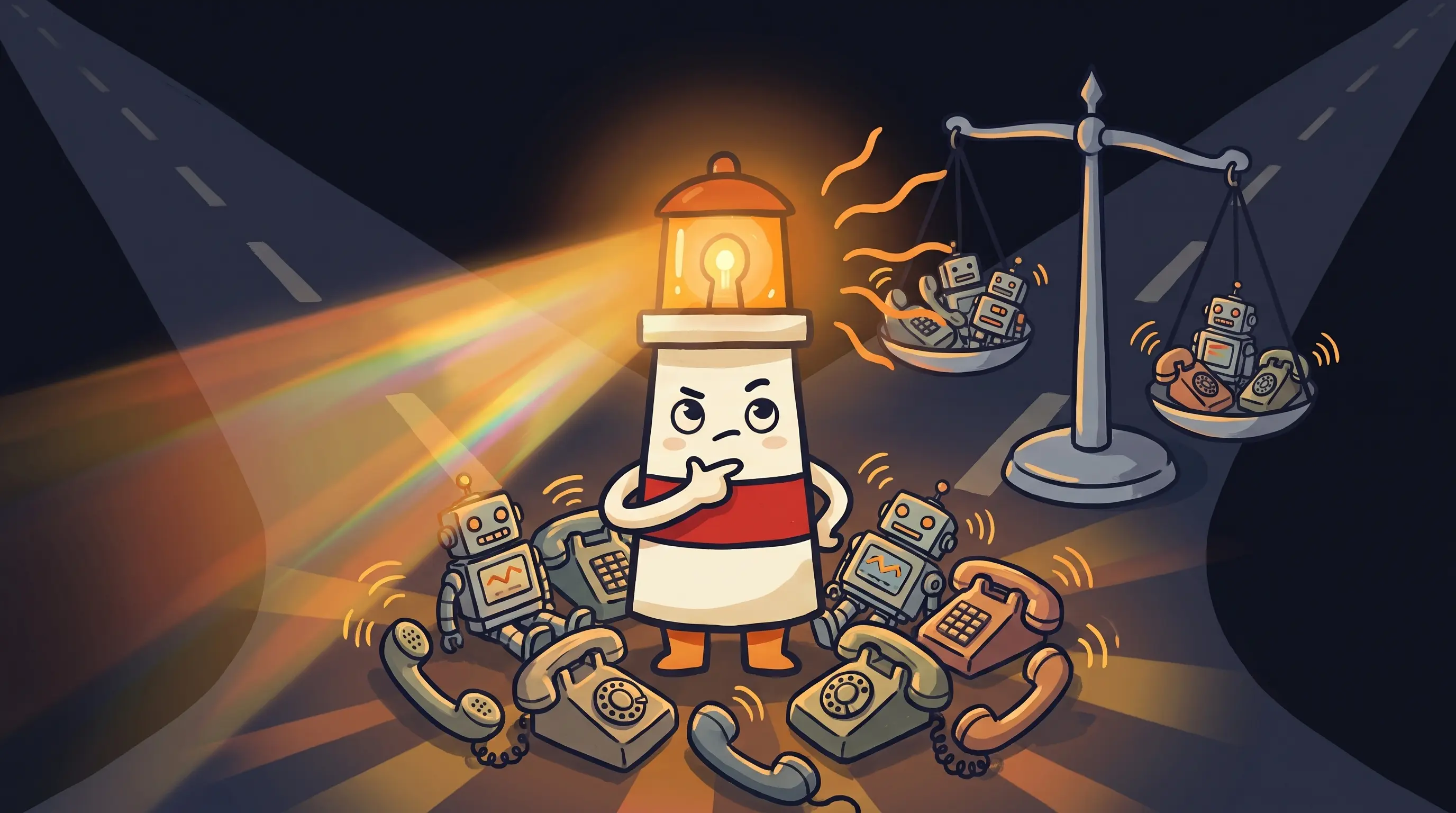
Traditional automation can’t fix this. Rule-based systems can send a canned “Thanks for your interest!” email, but they can’t understand what the lead actually asked for. They can’t qualify. They can’t answer questions. They can’t route the hot lead to your calendar while deprioritizing the tire-kickers. An AI sales agent can do all of that — in the time it takes you to read this sentence.
What an AI Sales Agent Actually Does
Unlike traditional automation that follows static, predefined rules, AI sales agents can understand context from emails, chats, and CRM records. They interpret buyer intent and sentiment. They decide which actions to take next. And they execute tasks across multiple systems automatically.
Think of it this way: a rule-based system is a vending machine. Put in a specific input, get a specific output. An AI sales agent is more like a trained employee who knows your business, can improvise, and gets better over time.
 Beacon says: in sales, every second counts—and so does every lead that gets your attention right away.
- Monitors lead sources (forms, emails, chat widgets, social messages) around the clock
- Responds to new inquiries in under 15 seconds with personalized, context-aware messages
- Qualifies leads by asking smart follow-up questions based on your ideal customer profile
- Routes hot leads directly to your calendar while nurturing cooler prospects
- Updates your CRM automatically so your records stay clean without manual data entry
- Learns from outcomes to improve scoring and response quality over time
The best AI agents don’t try to do everything. They solve one problem extremely well. They integrate with your existing tools. And they make your team more effective without requiring a PhD to operate.
The 15-Second Response Framework
Speed alone isn’t enough. Responding in 15 seconds with a generic “Someone will be in touch” wastes the opportunity. Here’s the framework that actually converts:
- Acknowledge specifically — Reference what they asked about. “You mentioned you’re looking for help with contractor quotes for your roofing business” beats “Thanks for reaching out” every time.
- Answer the immediate question — If they asked about pricing, give a range. If they asked about timing, give an estimate. Don’t make them wait for basic information.
- Qualify naturally — Ask one smart question that reveals intent. “Are you looking to implement this quarter, or still in research mode?” separates tire-kickers from buyers.
- Offer a clear next step — “I can get you on a call with our team this week — want me to send some available times?” Not “Let me know if you have questions.”
- Route based on response — Hot leads go to calendar. Warm leads go to nurture sequence. Cold leads get helpful resources but don’t consume rep time.
This framework works because it respects the lead’s time while gathering the intelligence your team needs. The AI handles the first four steps instantly. Your reps only see the leads who’ve already been qualified and are ready to talk.
Why Speed Beats Skill in Lead Response
Here’s the counterintuitive truth I promised: your most experienced sales rep, responding in three hours, loses to a mediocre AI response in 15 seconds. Every time.
It seems wrong. Surely a personalized, thoughtful response from a human expert should outperform a machine? But that’s not how buying psychology works. When someone fills out a form, they’re in decision-making mode. They’re comparing options. They’re ready to move. Three hours later, they’ve moved on to other problems.
The data backs this up. Companies using AI sales agents report 25-30% higher conversion rates, 40% less manual work, and lead response times reduced from hours to seconds. Organizations using AI sales tools see 43% higher win rates and 37% faster sales cycles compared to teams without them. Sales reps using AI are 3.7 times more likely to hit quota.
That 3.7x number stopped me cold when I first saw it. It’s not a marginal improvement. It’s a categorical difference. And it’s not because AI is smarter than humans — it’s because AI is faster.
Where AI Sales Agents Break Down
I’d be lying if I said this always works. After watching dozens of implementations, I can tell you exactly where they fail:
- Garbage data in, garbage decisions out — AI agents need accurate CRM information and well-defined ideal customer profiles to make smart decisions about which prospects deserve attention. If your CRM is a mess, your agent will be too.
- Overconfidence in automation — The agent handles qualification and initial response. It should NOT handle complex negotiations, custom pricing, or upset customers. Know where to draw the line.
- No feedback loop — AI gets better by learning which responses led to closed deals. If you’re not tracking outcomes back to initial engagement, the system can’t improve.
- Creepy personalization — There’s a line between “helpful” and “how did you know that?” Reference what they told you, not what you scraped from public profiles. People can tell the difference.
- Integration gaps — An AI agent that can’t talk to your calendar, CRM, and email is just a fancy chatbot. The value is in the connected actions, not the conversation.
The vendors won’t tell you this: about 30% of AI sales agent implementations underperform because of data quality issues, not technology limitations. Clean your CRM first. Define your ideal customer profile second. Deploy the AI third.
How to Know Your Agent Is Working
Don’t trust vendor dashboards. Track these metrics yourself:
- Response time — Should be under 60 seconds for any channel. Under 15 seconds is the target.
- Lead-to-meeting conversion rate — Compare before and after. You should see 25%+ improvement within 30 days.
- Rep time on qualified leads — Your sales team should spend MORE time on actual selling, LESS time on data entry and cold outreach.
- CRM data accuracy — Spot-check 10 records per week. Are they complete? Are lead scores accurate?
- Customer sentiment in initial response — Review actual conversations. Do leads engage or go silent after the AI response?
AI agents can achieve 90% accuracy in predicting conversion potential, compared to 60-70% for traditional scoring methods. But that accuracy depends on clean data and continuous feedback. If your numbers aren’t improving after 30 days, the problem is usually in the setup, not the technology.
Your First Week With an AI Sales Agent
Here’s how to start without betting your pipeline on untested technology:
- Audit your current response time — Check your last 20 leads. How long between form submission and first meaningful response? If it’s over 2 hours, you’re already losing deals.
- Clean 100 CRM records — Not your whole database. Just your most recent leads. Make sure company size, industry, and contact info are accurate. This is your agent’s training data.
- Define your qualification criteria — Write down the 3-5 questions that separate buyers from browsers. Budget range? Timeline? Decision authority? Your agent needs these rules.
- Start with one channel — Don’t deploy across every lead source simultaneously. Pick your highest-volume source (usually web forms) and nail that first.
- Set your handoff threshold — Decide exactly when a lead goes to a human. Hot lead with meeting booked? Human. Complex technical question? Human. Everything else? Agent handles it.
- Run parallel for 2 weeks — Let the AI respond while also alerting your team. Compare conversion rates. You’ll see the speed difference immediately.
- Budget $200-500/month for the first 90 days — That covers most AI sales agent tools plus your API costs. If you’re not seeing ROI within 60 days, something’s wrong with the implementation, not the concept.
Want to explore how a personal AI agent fits into your broader workflow — handling not just sales leads but scheduling, email, and client communication? Check out our guide to AI automation for the full picture. And if you’re evaluating platforms to host your agent, our AI agent platform comparison breaks down the options.
Common Questions About AI Sales Agents
How much does an AI sales agent cost?
Most AI sales agent tools run $200-500/month for small teams, with enterprise pricing scaling based on lead volume. Some vendors claim 90% cost savings compared to hiring additional reps, but that assumes the AI handles tasks that would otherwise require headcount. The real ROI calculation is: (leads you’re currently losing to slow response) × (average deal value) × (improvement in conversion rate). For most businesses, even one additional closed deal per month justifies the cost.
Will an AI sales agent replace my sales team?
No — and vendors who claim otherwise are overselling. AI handles the repetitive, time-sensitive work: initial response, qualification questions, meeting scheduling, CRM updates. Your reps still close deals, handle complex negotiations, and build relationships. The goal is to give your best salespeople more at-bats with qualified prospects, not to eliminate them.
How long does it take to see results?
Response time improvements are immediate — day one. Conversion rate improvements typically show up within 2-4 weeks as the faster response cadence works through your pipeline. The full impact on closed revenue takes 60-90 days, depending on your sales cycle length. If you’re not seeing measurable improvement in lead-to-meeting conversion within 30 days, something’s wrong with your setup.
What happens when the AI gets a question it can't answer?
Good AI sales agents have escalation rules built in. Complex technical questions, pricing negotiations, and upset customers should route to humans immediately. The agent should acknowledge its limitations naturally — “That’s a great question. Let me get one of our specialists on a call with you to dig into the details” — rather than making up answers or going silent.
Is my data safe with an AI sales agent?
This depends entirely on the vendor and your configuration. Key questions to ask: Where is data stored? Who has access? Is conversation data used to train models? For sensitive industries, look for SOC 2 compliance and the option to use your own API keys (BYOK — bring your own API key) so data flows through your accounts rather than the vendor’s. Never deploy an AI agent that stores customer conversations without understanding exactly where that data goes.