Free AI Answering Service: What You Get Free vs What Actually Works

On this page
You’ve already looked at a few options. You’ve seen the pricing pages. And you’ve noticed something: every platform says it’s free, but none of them say the same thing about what that actually means.
That confusion is deliberate. The free AI answering service market has a labeling problem that benefits nobody except the platforms running it. We’ve been deploying AI agent infrastructure for years, and the gap between what gets advertised as ‘free AI answering’ and what actually functions as one is wide enough to drive a truck through. If you’re evaluating options right now, understanding that gap is the only thing that saves you from a painful month of testing tools that were never going to work for your volume.
There’s a deeper issue underneath the pricing question — something about how these tools are architected that determines whether they can actually represent your business. I’ll get to that after we clear up the labeling problem. First, the three buckets everything falls into.
If you’re exploring the broader landscape of what a capable AI virtual assistant can do for a business, start there first, then compare it with BrainRoad’s AI receptionist route when you’re deciding whether a free answering tier is enough.
What ‘Free AI Answering Service’ Actually Means
One analysis of platforms advertising free AI chatbots found they consistently conflated three very different things. Knowing which bucket you’re looking at saves hours of testing.
Free live chat (no AI)
A human agent answers every message. This is free customer support software, not a chatbot. It's labeled AI because AI-adjacent branding converts better. No language model involved.
Free rule-based bots
Decision trees and keyword triggers. They handle the scenarios the vendor scripted. They break the moment someone asks an unexpected question — which happens constantly in real calls. This was the state of the art in 2019.
Free tiers on actual AI platforms
Genuine language model access, but rate-limited, capped on features, or time-limited. This is where real evaluation starts — and where the fine print matters most.
The third bucket is what most people are actually looking for. It exists. But it comes with constraints that aren’t always visible until you’re mid-deployment.
Where Free AI Answering Services Break Down
Let’s be specific about what gets stripped out on free plans. According to IONOS’s analysis of free AI assistant options, common restrictions include usage caps, narrow integration limits, and reduced control over how the system behaves in production. AI capabilities are reduced. CRM integrations are gated. Audit-oriented features are often absent. The result is the same: you can test the model, but you can’t trust it with a real customer-facing workflow.
On the chatbot side, platforms like Free.ai use token-based consumption models that create hidden cost structures even on nominally free accounts. Premium models like GPT-4o consume around 2,000 tokens per message. Claude Opus 4 consumes up to 5,000 tokens per message. You start the month with a token balance, not a subscription. That balance depletes faster than most businesses expect.
The same pattern holds for API-level access. Google AI Studio’s free tier for Gemini 2.5 Pro is rate-limited to 5–15 requests per minute and 250,000 tokens per minute. Groq’s free tier for Llama 3.3 70B allows 30–60 requests per minute with a cap of 1,000 requests per day for the 70B model. OpenRouter offers DeepSeek R1, Llama 4, and Qwen3 at no cost with no credit card required — but subject to similar rate constraints. These are genuine frontier models. They’re just not designed for uninterrupted business-volume traffic.
Here’s what that means in practice. A contractor business receiving 42 inbound requests per month might look at those limits and think they’re fine. But an analysis of 13,175 inbound contacts from 47 home services contractors found 74.1% went completely unanswered over seven months. The businesses with that miss rate aren’t missing demand because they lack AI — they’re missing it because nothing is consistently on. Free-tier rate limits and session gaps create exactly those windows.
The math on missed inbound demand is unforgiving. For a contractor receiving 42 inbound requests per month with that 74% miss rate, even a 20% conversion rate at a $3,500 average project value represents around $21,700 per month in lost revenue. A tool that goes dark at 11 PM because you hit a daily request cap isn’t a free solution — it’s a paid problem you haven’t invoiced yet.
What the Token Math Reveals About Free AI Answering
There’s a reason the business owners we’ve talked to who searched for free AI answering services aren’t looking for free because they’re budget-constrained. BotHero’s analysis of 11 platforms and 14,000 conversations found that most of them had been burned by $300/month traditional answering services that forwarded garbled messages. They want proof AI works before committing budget. That’s a reasonable position.
But here’s what most of them discover: the mistakes that come from choosing a free tool that fails operationally end up costing more than paying for the right tool from the start. The tool that silently stops responding after 1,000 daily requests, the chatbot that gives your customer a wrong refund policy because it wasn’t trained on your content — those aren’t free errors.
AI customer service tools can resolve 60–80% of support conversations when properly trained on your content. That number is the ceiling, and it’s only achievable with persistent context and business-specific training. A rate-limited free tier with no memory between sessions doesn’t get you there. It gets you closer to zero.
The AI Employee Model vs. The Free Tool Model
This is the part that explains why some AI answering deployments work and others don’t — regardless of price.
Most free AI answering tools are built on a stateless model. You send a message. It responds. The session ends. The next inbound request starts from scratch. There’s no accumulated knowledge about your business, no consistent identity presented to every customer, no record of what was promised or resolved. You can’t audit it. You can’t hold it accountable. It’s a tool, not a representative.
What actually works is architecturally different. Think about what you’d expect from a new employee handling inbound customer requests. They’d know your products. They’d follow your refund policy. They’d know which requests to escalate and which to resolve. They’d have a record of every interaction. And critically, they’d have a consistent identity — the same operating role, the same knowledge base, every time.
That’s what persistent context and governed execution provide. Not just a model, but a model trained on your content, operating within defined rules, producing a log of every action taken. The configuration — the persistent identity layer, the memory layer, and the approval layer — is what creates a dependable customer-facing worker. Free tiers don’t include that stack.
For a deeper look at how capable AI agents handle customer-facing conversations end to end, use the AI receptionist route for the product view and the AI virtual assistant pillar for the broader category context.
The benchmark question isn’t which free model scores highest. Kimi K2 hits 53.7% on LiveCodeBench compared to GPT-4’s 44.7% — impressive numbers, genuinely. But LiveCodeBench measures coding reasoning, not answering service performance. Benchmark scores are proxies for capability, not predictors of whether your customers will get accurate information about your business hours at 9 PM on a Sunday.
Tradeoffs Across Free and Paid AI Answering Service Tiers
Here’s the honest comparison across the spectrum. Paid AI answering services run $34–$250/month at flat rates. Traditional human answering services run $200–$1,500/month. Free tiers run $0 but come with the constraints below.
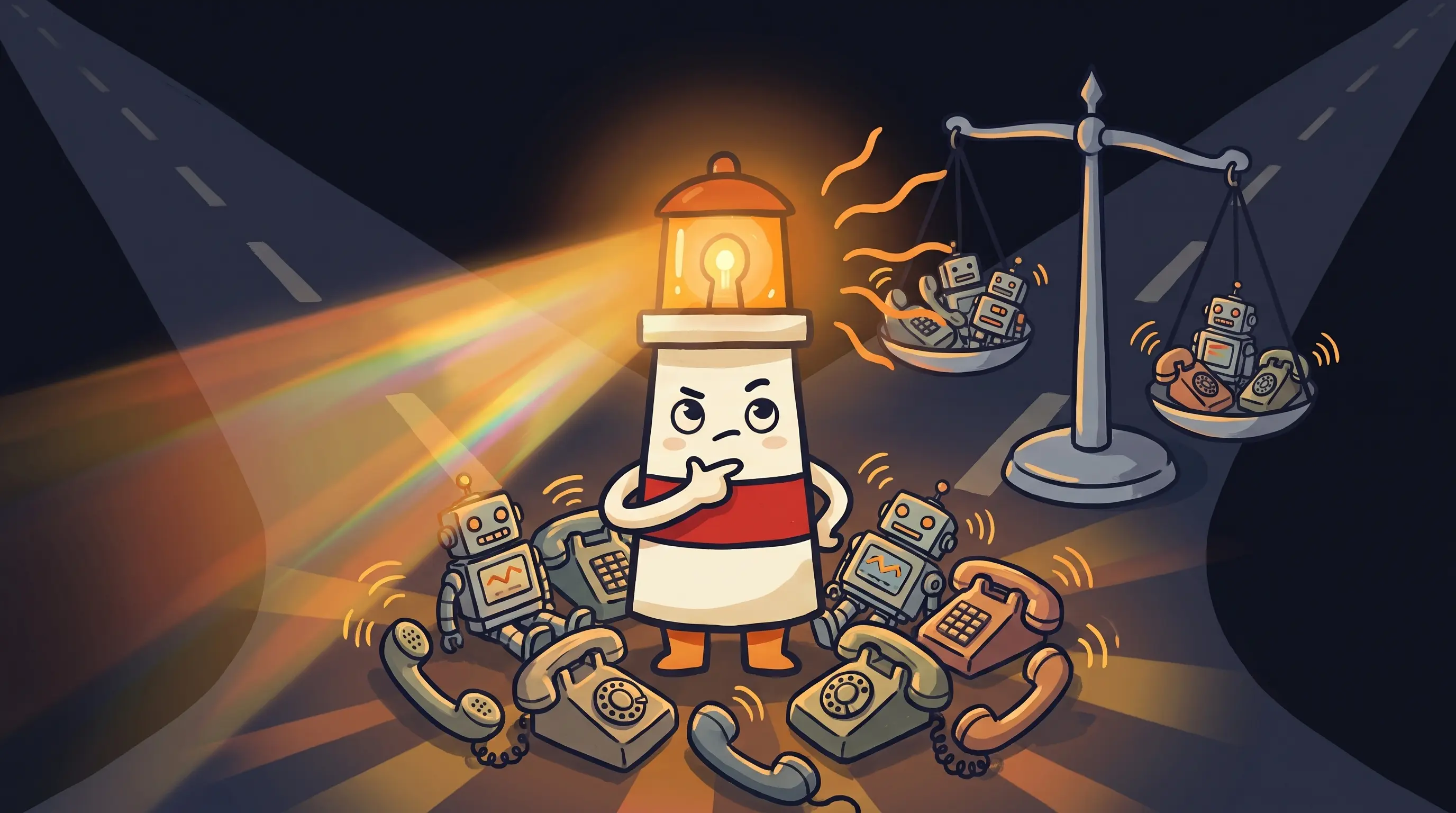
 Free doesn’t always mean useful. Beacon’s shining a light on the fine print so you can see exactly what you’re actually getting.
- Rate limits create coverage gaps. Free API tiers cap at 1,000–1,500 requests per day for high-capability models. For businesses with real inbound volume, this means the AI goes silent before the business day ends.
- No persistent context means no institutional memory. Each session starts fresh. The AI can’t remember that the customer asked the same question last week, can’t track open issues, can’t maintain a conversation thread across contacts.
- Compliance features are gated. GDPR-grade handling, HIPAA-grade data controls, and audit logs are consistently unavailable on free plans.
- CRM integrations require paid tiers. Connecting your answering AI to your customer database, your ticketing system, or your scheduling tool is not a free feature on any platform we’ve reviewed.
- Custom workflow rules are paid-only. If you want the AI to handle a return differently than a general inquiry, that logic lives behind a paywall.
- The 14-day trial trap. Many platforms advertise ‘free AI chatbot’ and mean a trial that auto-converts to a paid plan. The functionality works — until it doesn’t, and then you’re mid-billing-cycle.
How to Know If a Free AI Answering Service Will Actually Hold Up
Before you commit time to testing any free tier, check these things first. The answers tell you whether you’re evaluating a real option or a trial with extra steps.
- What happens when the daily limit hits? Does the service fail silently, display an error to customers, or queue requests? Silent failure is the most damaging option for a business.
- Is there persistent storage across sessions? Ask directly. Most free tiers will tell you the answer in the documentation if you look for the word ‘context’ or ‘memory.’
- Can you train it on your content? Not upload a document — actually train it so responses reflect your specific policies, pricing, and procedures.
- Where is the call log? If there’s no audit trail, you have no way to verify what the AI told your customers.
- What triggers an upgrade requirement? The feature that matters most to your use case is usually the first one gated.
Your Week-One AI Answering Service Evaluation Checklist
If you’re running a structured evaluation of free vs paid AI answering options, this is the sequence that produces useful data.
Map your actual inbound volume
Pull 30 days of inbound contact data. Count daily peaks, not monthly averages. A free tier rated at 1,000 requests/day fails if your Tuesday spikes hit 1,200.
Test the off-hours scenario first
Configure the free tool and send 10 test contacts after 6 PM on a weekday. If it handles those without hitting a rate limit or dropping context, it can handle daytime volume too.
Ask three questions the AI shouldn't know by default
Your refund policy. Your current pricing. Your service area. If the free tier can't answer these accurately from your content, it cannot represent your business — regardless of model quality.
Check the audit trail
Log 20 real interactions. Pull the transcript for each. If you can't review what was said, you're operating blind. Any free tier without logging is disqualified for business use.
Calculate the real weekly cost
Add time spent: configuring workarounds, handling escalations the AI fumbled, re-answering questions the AI answered wrong. If that time exceeds 2 hours per week, a paid service at $34–$250/month saves money.
If the free tier works, document the ceiling
Note exactly which features you'd need to upgrade for. Then price that upgrade. For most businesses, free plans work best as a starting point to test the technology — not as the long-term solution.
What This Means for Your AI Answering Strategy
- Most platforms advertising ‘free AI answering’ are offering one of three things: no AI, rule-based bots from 2019, or rate-limited trials. Genuine free tiers exist but come with daily request caps and no persistent context.
- The 60–80% resolution rate that makes AI answering services worthwhile only happens when the AI has your content, consistent memory, and governed execution rules — none of which are standard on free tiers.
- 74.1% of inbound contacts to home services contractors go unanswered. A free AI tool that hits its daily cap at 8 PM doesn’t solve that problem — it renames it.
- AI answering services on paid plans run $34–$250/month flat. Traditional human answering services run $200–$1,500/month. The evaluation question is whether the free tier bridges you to the paid one, or wastes the month you needed to spend on something that works.
- Benchmark scores (model vs model) don’t predict answering service quality. Persistent identity, governed execution, and proof of work do. Evaluate on those dimensions.
The teams that figure this out early get something the late adopters don’t: a compounding knowledge base. Every interaction an AI answering service handles adds to what it knows about your customers, your common questions, your edge cases. A free tier that resets context on every session doesn’t compound. It just responds. The gap between those two architectures grows wider every month — and it doesn’t shrink when you eventually upgrade, because you’ve lost the data that would have trained it.
If you want the practical upgrade path, start with the AI receptionist route and compare it against the AI virtual assistant pillar. That contrast makes the real free-vs-governed tradeoff obvious: session access is easy to get free, but persistent identity, memory, approvals, and proof of work are where business use actually begins.
Frequently Asked Questions
Is there a genuinely free AI answering service that works for businesses?
Yes, with limits. API providers like Google AI Studio, Groq, and OpenRouter offer free access to frontier models including Gemini 2.5 Pro and Llama 3.3 70B without requiring a credit card. These are legitimate, capable models — but they’re rate-limited (5–15 requests per minute for Google AI Studio, 30–60 for Groq) and have no business logic, persistent context, or call logging built in. They work for testing. They don’t work as a production answering service without significant configuration layered on top.
What do free AI answering service plans typically leave out?
Based on analysis of multiple platforms: custom workflow logic, CRM integrations, audit-ready handling, and persistent memory across sessions. Most free plans also cap usage aggressively and reduce AI model capability compared to paid tiers. These aren’t minor omissions — they’re the features that determine whether the AI can actually represent your business.
How much does a paid AI answering service cost compared to a human service?
Paid AI answering services run $34–$250/month at flat rates. Traditional human answering services run $200–$1,500/month. For most small businesses, the cost comparison isn’t close — the question is whether the AI tier you’re evaluating includes the features you need, not whether it’s cheaper than a human receptionist.
Can an AI answering service resolve most customer questions without a human?
When properly trained on your business content, AI customer service tools can resolve 60–80% of support conversations without human intervention. That resolution rate depends on the AI having access to your actual policies, pricing, and procedures — and on having persistent context so it doesn’t start fresh on every contact. Free tiers that reset between sessions don’t achieve that ceiling.
What's the real cost of missed calls for a small business?
An analysis of 13,175 inbound contacts from 47 home services contractors found 74.1% went unanswered. For a contractor receiving 42 inbound requests per month, that’s roughly 31 missed contacts. At a 20% conversion rate and $3,500 average project value, that’s around $21,700/month in lost revenue. The cost of a free tool that goes dark when it hits a daily request limit isn’t zero — it’s whatever those missed contacts were worth.
How do I evaluate whether a free AI answering service is worth testing?
Check four things before investing time: (1) What happens when the daily request limit is reached — does it fail silently? (2) Does it retain context between separate contacts from the same customer? (3) Can you train it on your specific business content? (4) Does it produce a searchable log of every interaction? If the answer to any of those is no, you’re testing a demo, not a production tool.
Want the truthful public route for receptionist-intent buyers?
Use the canonical AI receptionist page if the real problem is front-desk continuity, after-hours capture, and governed escalation across your configured channels.
Open the AI Receptionist RouteRelated BrainRoad guides
Sources
- ChatGPT Free Tier FAQ — OpenAI Help Center
- Best Free AI Chatbot for Website in 2026 — Canary
- Free AI Phone Assistant Options — IONOS
- Free AI Answering Service: 11 Platforms Tested — BotHero
- Best AI Answering Services 2026 — NextPhone
- Best AI Answering Service 2026 — Autocalls
- AI Answering Services Small Business Guide — AI Assistant
- Best AI Customer Service Tools 2026 — Chatsy
- Every Free AI API in 2026 — Awesome Agents
- AI Phone Answering Service: The Complete Guide — OnCallClerk
- Free AI Chat — Free.ai
- Kimi K2 AI Chat Assistant