Personal AI Virtual Assistant vs AI Agent: What is the Difference

On this page
Your competitor’s team of three closes faster than your team of twelve. You’ve watched it happen. They respond to leads in minutes. Proposals go out same day. Follow-ups never slip. They’re not working harder. They’re not smarter. But they stopped using tools that wait to be asked — and started using tools that just act.
The distinction sounds subtle. It isn’t. The gap between a personal AI virtual assistant and an AI agent is architectural — and if you pick the wrong category, you’ll spend real money automating nothing. The part most comparisons skip is WHY they behave so differently. I’ll get to it after the framework, but it comes down to a single design choice that determines everything else.
Why People Confuse These Two Things
Both categories use AI. Both respond in natural language. Both can handle scheduling and email questions. And vendors on both sides have every incentive to blur the line — assistants want to sound more autonomous, agents want to sound less intimidating.
The confusion is expensive. Misidentifying which tool you actually need leads to wasted budgets and failed implementations — your team ends up with an assistant and wonders why it’s not working autonomously, or buys an agent platform and can’t figure out why it needs so much configuration. These aren’t two versions of the same thing. They solve different problems at a structural level.
The AI agents market was projected to reach $7.6 billion in 2025, up from $5.4 billion in 2024. That’s rapid category growth — which means a lot of organizations are buying in before they’ve mapped exactly what they’re getting. Gartner forecasts that by 2029, AI agents will autonomously resolve 80% of routine service issues. That number requires agents with persistent memory and autonomous execution — not assistants that wait for prompts.
If you’re exploring personal AI assistants for the first time, the distinction we’re about to draw will save you a lot of frustration.
What AI Virtual Assistants Actually Do (and Where They Stop)
Siri, Alexa, Google Assistant, ChatGPT, Claude, Copilot — they’re all variants of the same architecture. You initiate. They respond. The session ends. Nothing carries over.
That’s not a criticism. It’s a design choice. AI assistants are built to augment human decision-making while keeping the human in control. You initiate every interaction. You evaluate every response. They don’t act between your requests — they wait.
Session-Based Memory
Conversations reset between sessions unless memory features are explicitly added. The assistant doesn't know what you discussed yesterday unless you tell it again.
Reactive by Design
Nothing happens until you ask. No follow-ups, no proactive outreach, no background execution. The human remains in the loop on every action.
Ecosystem-Locked
Siri lives in Apple. Alexa lives in Amazon. Google Assistant lives in Google. Moving between platforms means starting over.
Strong at Conversation
Drafting, summarizing, answering questions, brainstorming — assistants excel at anything that starts with a human prompt and ends with a response.
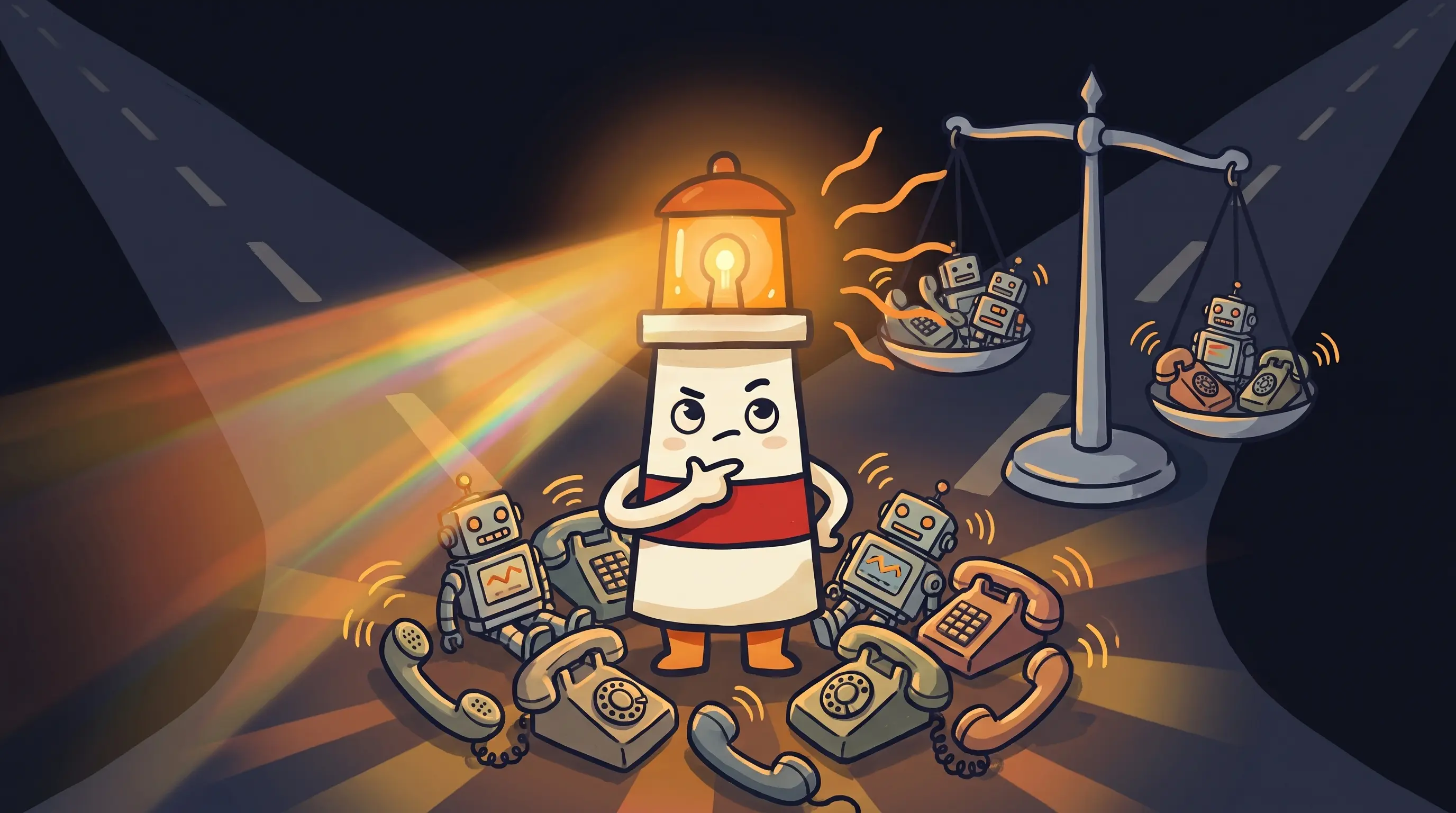
 Some things only get confusing when you’re using the wrong word for them — assistant or agent, Beacon knows the difference matters.
Rule-based chatbots (the FAQ bots on most company websites) sit at the simpler end of this category: predefined scripts, no memory, no reasoning. They handle FAQ support, order status tracking, appointment booking, basic lead capture. Useful for simple, repetitive interactions. They break immediately outside their scripts.
Microsoft positions Copilot as bridging this gap — it answers questions AND helps you plan, create, and execute tasks. That’s accurate, but Copilot still operates on a prompt-response model. You still initiate. The question is how much help you get per initiation, not whether the tool acts when you’re not watching.
What AI Agents Actually Do (and What That Enables)
An AI agent runs continuously. It doesn’t wait for you to open a chat window. It maintains memory of everything that’s happened before. It integrates with external tools and can trigger actions in them. And it can initiate — reaching out, following up, escalating — without waiting for your prompt.
Here’s a scenario that illustrates the gap. A lead fills out a contact form at 11 PM on a Tuesday. An AI assistant does nothing — there was no prompt. An AI agent reads the submission, checks the CRM, drafts a personalized response based on prior email history, sends it, schedules a follow-up for 48 hours later, and texts you a summary Wednesday morning. Same technology stack underneath. Completely different behavior.
Platforms like OpenClaw, Auto-GPT, and CrewAI represent this category — they persist between sessions, connect to external tools, and can act on your behalf without a human in the loop on each step. Unlike assistants locked to one ecosystem, agents can live across Discord, Telegram, Slack, and WhatsApp simultaneously.
The tradeoff is real: with more autonomy comes more configuration. You have to define the rules. You have to set the guardrails (safety rules that prevent the agent from taking actions you didn’t authorize). The agent doesn’t guess what you want — it executes what you’ve specified.
The Architecture That Actually Separates Them
Here’s the thing most comparisons miss: this isn’t a capability gap. It’s a control model.
AI assistants are designed to keep you in control. The human initiates, the tool responds, the human decides what to do next. That’s not a limitation — it’s the product philosophy. For tasks where you want final judgment on every step, that’s exactly right.
AI agents are designed to remove you from the loop. The agent initiates, executes, and reports — and you step in only when it can’t resolve something on its own. For tasks where the steps are predictable and your judgment adds no value at 3 AM, that’s exactly right.
That design choice cascades into every other difference. Memory persistence exists in agents because they need to track state across autonomous execution. Multi-platform integration exists because agents need to reach across tools to complete tasks. Proactive initiation exists because an agent waiting for a prompt isn’t running autonomously — it’s just a reactive assistant with extra steps.
A user who runs a personal AI agent connected to WhatsApp described it this way: by Thursday morning, his agent had sorted 47 emails, replied to three client inquiries, and sent him a two-item summary of what needed his attention. He didn’t open his email until noon. The agent didn’t wait for permission between steps — it executed the workflow he’d defined once, and ran it continuously.
How to Choose: A Decision Framework
The choice comes down to three questions about your specific task.
If you’re still mapping out which category fits your workflows, the broader landscape of AI virtual assistants and how they compare to full agents is worth understanding before committing to a platform.
Use an AI Virtual Assistant when:
- You want to stay in the loop on every decision
- The task is conversational: drafting, summarizing, answering
- You need it now, with minimal setup
- The workflow is unpredictable or requires your judgment
- You’re handling sensitive decisions that shouldn’t be automated
Use an AI Agent when:
- The task should happen without your involvement
- Memory across sessions matters (follow-ups, ongoing projects)
- You need cross-platform execution (CRM + email + calendar)
- The workflow is repeatable and the steps are predictable
- You want proactive initiation, not just reactive responses
The chatbot industry is expected to exceed $100 billion by 2034. That scale is built on simple, repetitive interactions — FAQ support, order status, appointment booking. These are the use cases where a rule-based assistant or basic chatbot is genuinely the right tool. Not every automation problem needs an autonomous agent. Reach for the right lever.
In practice, organizations often run both: assistants for knowledge work and conversation (drafting, research, decision support), agents for operational execution (follow-ups, scheduling, triage, reporting). They’re not in competition. They serve different parts of the workflow.
Where Each One Breaks
A Friday afternoon test that felt clean will break Monday morning in production. Here’s what to watch for.
AI virtual assistant failure modes:
- Context amnesia — you explained the project last week, the assistant has no idea what you’re talking about today
- Passive gaps — time-sensitive tasks don’t get done because nobody prompted the assistant
- Ecosystem walls — Siri can’t check your Gmail, Alexa can’t update your CRM, Google Assistant can’t reach your Slack
- Delegation ceiling — you can ask it to draft something, but it won’t send it without you touching it first
AI agent failure modes:
- Scope creep — a poorly configured agent takes actions you didn’t intend because the boundaries weren’t explicit
- Configuration debt — the upfront setup investment is real; agents don’t configure themselves
- Over-automation — automating tasks that actually benefit from human judgment at every step creates errors that compound
- Opaque execution — if you can’t audit what the agent did and why, you can’t debug it when something goes wrong
Neither failure mode is fatal if you see it coming. The agentic AI category is maturing fast — the tooling for guardrails and audit trails is much better than it was 18 months ago.
Your Decision Checklist for This Week
Audit one workflow
Pick the single most repetitive task eating your team's time. Map how many steps it involves and whether any step genuinely requires human judgment. If fewer than 2 steps require judgment, it's an agent candidate.
Check your memory requirement
Does this task need context from previous interactions — client history, prior emails, past decisions? If yes, a session-based assistant will fail you. You need persistent memory, which means an agent architecture.
Map your integration requirements
List every tool the task touches: CRM, email, calendar, Slack, project tracker. If the task spans more than 2 tools and one of them isn't native to your assistant's ecosystem, assistants will hit a wall. Agents integrate across platforms by design.
Set your control threshold
Define which actions require your approval before execution and which can run autonomously. A good rule: anything involving money, external communications, or irreversible changes should escalate to you. If you're unsure, start conservative — approval required for all actions — and loosen over the first 2 weeks as you build confidence in the agent's outputs.
Pilot with a 48-hour window
Run the agent in read-only or draft mode for 48 hours before giving it execution permissions. Review every action it would have taken. If accuracy exceeds 80%, expand to full execution. If not, tighten the configuration before going live.
Budget for the full stack
A managed agent platform typically runs $29–$50/month for hosting. Add $8–$15/month in API costs for typical usage. Total: roughly $40–$65/month. Compare that to the cost of a task that takes 2 hours/day — at $50/hr, that's $2,600/month in staff time. The math usually clears quickly.
What This Means for Your Automation Strategy
- AI virtual assistants and AI agents differ architecturally, not just in capability level — assistants keep you in control by design; agents remove you from the loop by design.
- Session-based memory vs. persistent memory is the most practical distinction: if your automation needs to remember context across days or weeks, you need an agent.
- Reactive vs. proactive initiation determines whether the tool waits for your prompt or executes on its own schedule — critical for time-sensitive workflows like lead follow-up.
- Gartner forecasts agents will autonomously resolve 80% of routine service issues by 2029 — but only for organizations that configure them correctly, with clear decision boundaries and escalation rules.
- Start with one well-defined workflow, pilot in draft mode for 48 hours, and expand permissions only after confirming accuracy. Don’t deploy broadly on day one.
The question was never which is better. It’s which control model fits your workflow. Assistants are the right call when human judgment belongs at every step. Agents are the right call when the steps are defined and your time is better spent elsewhere. Once you see it that way, the decision is usually obvious — and so is the cost of getting it wrong.
Frequently Asked Questions
Is ChatGPT an AI assistant or an AI agent?
ChatGPT is an AI assistant. It’s session-based — memory resets between conversations unless you’ve explicitly enabled memory features. It responds when you prompt it and stops when you close the window. It doesn’t take actions between sessions or initiate contact on your behalf. The same applies to Claude and standard Gemini. These are sophisticated conversational tools, not autonomous agents.
Can an AI virtual assistant become an AI agent?
Not by switching a setting. The difference is architectural. An assistant can be extended with memory plugins and tool integrations that approximate some agent behaviors, but the core design — reactive, session-based, human-initiated — doesn’t change. Building true agent behavior (persistent memory, autonomous execution, proactive initiation) requires a different infrastructure stack, not just add-ons to an assistant interface.
What's the fastest way to tell if I need an agent or an assistant?
Ask whether the task needs to happen when you’re not watching. If the answer is yes — a lead comes in at midnight, a follow-up is due while you’re in a meeting, a report needs to run every morning before you wake up — you need an agent. If you’re always available to initiate and the task is conversational, an assistant handles it fine.
Do AI agents require technical expertise to set up?
It depends on the platform. Self-hosted options like Auto-GPT or CrewAI require meaningful technical configuration — you’re writing workflow definitions, setting tool permissions, and managing infrastructure. Managed platforms like BrainRoad use wizard-based onboarding that walks you through configuration without writing code. The tradeoff is control vs. setup time: developer-focused platforms give you more granular options, managed platforms get you running in under an hour.
Which is right for small businesses vs. enterprises?
Both can work at either scale. Small businesses often start with AI assistants for customer-facing interactions and graduate to agents when they identify specific repetitive workflows worth automating. Enterprises typically run both simultaneously: assistants for knowledge workers doing research and drafting, agents for operational processes like lead follow-up, scheduling, and service ticket routing. The deciding factor is workflow complexity and the cost of human time, not company size.
Related BrainRoad guides
Sources
- AI Agent vs Chatbot: What’s the Difference? (2026 Guide) — DoneClaw
- AI Agents vs AI Assistants: Why One Replaces the Other — Ampere
- AI Agents vs Chatbots vs Virtual Assistants: A Practical Breakdown — Quixy
- AI Agent vs Chatbot vs Virtual Assistant — Alternates.ai
- AI Employee vs. AI Agent vs. AI Assistant: The Real Differences — Emika
- Understanding the difference between AI Agents vs. AI Assistants — Pieces
- Understanding AI agents vs. chatbots — Microsoft
- AI Agents vs Chatbots — openaiagent.io