Run Multiple AI Agents — One for Work, One for Personal, One for Your Side Project

On this page
Your work agent is answering questions about your side project. Your personal agent just scheduled a meeting over a client call. And all three of your ‘specialized AI workers’ are actually the same agent, taking turns, doing one thing at a time. You wanted a team. You got a very confused generalist.
The good news: running genuinely separate agents — each with its own context, its own channel, its own tool access — is no longer a weekend research project. The infrastructure exists. The tools are stable. What most guides skip over is how these agents actually divide the work, and why there’s a specific failure mode that will bite you if you don’t plan for it upfront. We’ll get to that in a moment.
If you’re exploring best AI agents for running multiple workflows, start with the architecture question before you pick tools. The tool choice is secondary. The separation model is everything.
Why One AI Agent Hits Its Ceiling
A single AI agent can only do one thing at a time. When it’s processing your emails, it isn’t watching for a price alert. When it’s writing a product spec for your side project, it isn’t monitoring Slack for an urgent client ping. This isn’t a software bug — it’s a design constraint.
There’s a second problem that’s less obvious but more damaging over time. When you push a single agent through a long project — a client engagement that spans weeks, a codebase you’re actively building — the agent’s working memory starts to fill up. Earlier decisions fall out of context. The agent forgets why you made the architecture call it’s now trying to undo. You end up re-explaining things to your own AI.
That’s the real ceiling. Not raw capability. Memory decay and task blocking.
Running parallel agents isn’t about raw horsepower. Your machine almost certainly has enough CPU and RAM. Agents spend most of their time on I/O — reading files, calling APIs, writing outputs — not burning cores. The question is whether you have the right structure to keep them from colliding.
How to Split Your Life Across Three Agents
Before touching a config file, make the conceptual split. Three domains, three agents, zero overlap.
Work Agent
Knows your codebase, your task backlog, your Slack threads. Lives in your work communication channel. Has access to work tools only — no personal calendar, no side project files.
Personal Agent
Knows your calendar, your email inbox, your household and family context. Reaches you through a personal messaging channel. Cannot see work projects or client data.
Side Project Agent
Focused on whatever you're building outside of work. Has access to that repo, that domain, that stack. Completely air-gapped from your day job context.
Why does the separation matter this much? Because an agent’s behavior is shaped by what it can see. Give it access to your entire life and it’ll cross streams constantly — drafting a work email with the tone of a personal one, or offering your side project architecture in a client context where it doesn’t belong.
The tool access question is the one that trips people up. You don’t just want separate agents — you want different tool policies. Your public-facing work agent probably shouldn’t have access to your personal cloud storage. Your side project agent doesn’t need read access to client contracts. Lock down permissions at the agent level, not as an afterthought.
There’s also a model selection angle worth thinking through. Not every agent needs to use the same underlying AI. You can point your personal agent at a faster, cheaper model for quick replies and route your deep-work coding agent to a more capable model for complex reasoning. Different costs, different latency, different contexts — matched to what each job actually demands.
What the Setup Actually Looks Like
Here’s a concrete picture of how this runs on a single machine.
Each agent instance gets its own isolated workspace — its own session history, its own authentication, its own directory. They’re not sharing memory. They’re not sharing credentials. From each agent’s perspective, it’s the only agent running. This isolation is what makes parallel operation stable rather than chaotic.
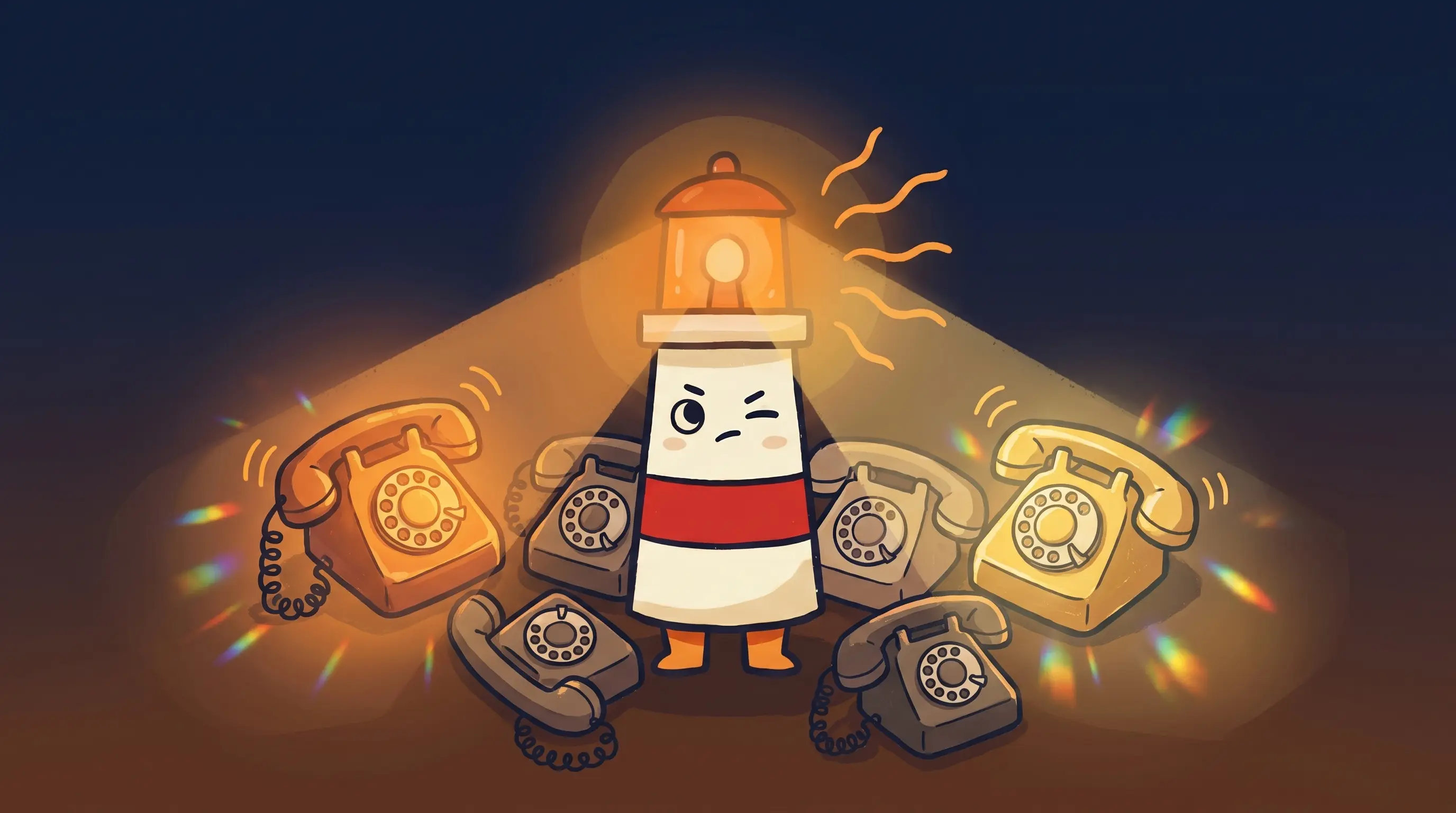
 Beacon says: one light was never going to be enough — good thing you can have a whole fleet.
Communication channels are where the three-agent model comes alive. Your personal agent might live in one Telegram bot, your work agent in a separate bot, your side project agent accessible via a dedicated WhatsApp number. You’re not switching between dashboards. You’re sending a message to the right number and the right agent answers.
For developers running multiple AI coding agents, the isolation gets more specific. Each agent needs its own git worktree — an isolated snapshot of the codebase where it can make changes without overwriting what another agent is doing in parallel. Without this, two agents working on the same repo will clobber each other’s progress. With it, they work independently and the results get merged deliberately.
Consider what this means for something like migrating twelve microservices or generating tests across four packages. Running those jobs sequentially means waiting hours for work that could finish in minutes. Each agent handles a subset, they run in parallel, you get everything back in a fraction of the time. That’s not hypothetical — it’s the practical arithmetic of parallel I/O.
Why the Bottleneck Isn’t Your Computer
Most people assume scaling to multiple agents is a hardware problem. Get a beefier machine, more RAM, more cores. That’s the wrong diagnosis.
Agents spend most of their working time on I/O — reading a file, calling an API, writing an output. They’re not burning CPU. A typical machine can run six, eight, or even ten agents simultaneously without breaking a sweat. The constraint isn’t compute at all.
The bottleneck is coordination.
How do you launch multiple agents without them interfering with each other? How do you monitor all of them without cycling through a dozen terminal tabs? How do you prevent two agents from writing conflicting changes to the same file? These are coordination problems, not performance problems — and they require different solutions.
This is why multi-agent orchestration tools exist. Some, like Manaflow for coding workflows, let you run Claude Code, Gemini CLI, and other coding agents across multiple tasks simultaneously and automatically selects the best result when they’re done — while leaving a manual override available if you want to review before accepting. Others, like the subagent architecture built into Claude Code, let a main orchestrator agent spawn child tasks directly, so you’re not building a custom coordination layer from scratch.
One pattern we’ve seen work well: an orchestrator agent that plans and delegates, paired with specialist agents that each get focused context — a coder, a researcher, a writer. Each one knows its lane. The orchestrator knows the plan. None of them are trying to do each other’s jobs.
Where Multi-Agent Setups Fall Apart
It’s Tuesday afternoon. You’ve got three agents running. Work agent is drafting a proposal. Side project agent is generating tests. Personal agent is… sitting idle because you haven’t set up its communication channel yet. You check your work agent. It’s been answering a question that belonged to the side project agent because you gave both of them access to the same repo.
This is what a messy multi-agent setup looks like in practice. Not catastrophic failure. Just quiet drift — agents doing the wrong jobs, outputs landing in the wrong places, context bleeding between domains.
Here’s what actually goes wrong, in order of likelihood:
- Shared tool access without intention — Two agents can read and write the same files, and neither knows the other exists. One overwrites the other’s work. No error. No warning.
- Context bleed — Your work agent gets given too much context (your calendar, your personal email) and starts making suggestions based on information it should never have seen.
- Token costs that compound fast — Running three agents that each make multiple API calls per hour adds up quickly. Before you scale, check whether you’re on a plan (like Claude Pro) that handles heavier consumption, or move to per-token billing with a clear budget cap.
- No monitoring layer — You can’t watch three terminal windows simultaneously. Without a way to see what all agents are doing at a glance, problems go undetected until they’ve compounded.
- Worktree conflicts in coding setups — If multiple coding agents are working in the same repository without isolated git worktrees, they will clobber each other’s changes. This is not recoverable without version control archaeology.
Your Multi-Agent Setup Checklist for This Weekend
Start with one agent. Get it working completely before you add the second. This sounds obvious. Almost nobody does it.
Define your three domains on paper first
Write down what each agent knows, what channels it uses, and what tools it can access. No overlap allowed. If you can't describe the separation clearly in plain language, you're not ready to configure it.
Set up your first agent (Personal) and run it for 48 hours
Connect it to one communication channel (WhatsApp, Telegram, or Signal). Give it access to your calendar and personal email only. Test it for two days before touching anything else.
Add your Work agent with strict tool isolation
Different workspace directory, different communication channel, different credentials. If you're a developer: separate git worktree, separate API keys. If you're not: different cloud folder, different email account access.
Assign models deliberately, not uniformly
Your personal agent handling quick replies doesn't need your most capable (and expensive) model. Route fast, simple tasks to a faster model. Save the heavy reasoning model for the agent doing complex research or deep coding work.
Set a token budget before your Side Project agent goes live
Three agents making multiple API calls per hour can cost $30-50/month more than you expect. If you're using Claude, check whether Claude Pro covers your usage or whether direct API access with a hard spend cap makes more sense for your volume.
Build a single monitoring view before you need it
Even a simple shared log or a tool like Manaflow's dashboard gives you visibility across agents. If one goes silent or starts producing garbage outputs, you want to catch it in minutes, not days.
One thing worth reading before you go deep on cost modeling: The Real Monthly Cost of Running a Personal AI Agent breaks down exactly what multi-agent API costs look like in practice. The numbers are less scary than most people assume — but only if you’ve set per-agent budget limits from the start.
If you’re thinking about where to host all of this without managing the infrastructure yourself, BrainRoad runs each agent in its own isolated container with persistent storage — so the separation model we described above is baked into the architecture rather than something you have to enforce manually.
What This Changes About How You Work
- A single AI agent can only do one task at a time — running three isolated agents means your work, personal, and side project contexts operate in parallel without blocking each other.
- The bottleneck in multi-agent setups isn’t your hardware — it’s coordination. Agents need isolated workspaces, separate communication channels, and distinct tool access to avoid interfering with each other.
- Parallel agents can reduce hours-long sequential tasks (like migrating services or generating tests across a codebase) to minutes, because agents spend most of their time on I/O, not CPU.
- Different agents can use different AI models — faster and cheaper models for high-frequency simple tasks, more capable models for deep reasoning work.
- Token costs multiply with each agent you add. Set per-agent budget limits before scaling to three or more concurrent agents.
Start with the personal agent. Not because it’s easiest — because it’s the one with the lowest blast radius if something goes wrong. Once you trust the isolation model, add the work agent. Once you trust the cost model, add the side project agent. The architecture scales naturally. The discipline required to keep contexts clean doesn’t — that part you have to build deliberately, not as an afterthought.
Frequently Asked Questions
Can I run multiple AI agents on a regular laptop?
Yes. Agents spend most of their time waiting on I/O — API calls, file reads, network requests — not burning CPU. A standard modern laptop can handle six to ten agents running simultaneously without performance issues. The limiting factor is coordination and API rate limits, not hardware.
What happens if two agents access the same files?
They’ll overwrite each other’s changes without warning. For coding setups, this is solved with git worktrees — each agent gets an isolated copy of the codebase to work in. For general file access, the fix is strict tool policies: each agent gets read/write access to only its designated directories. Shared access without a deliberate merge process is how multi-agent setups produce corrupted outputs.
Do all three agents need to use the same AI model?
No — and they probably shouldn’t. You can assign different models to different agents based on what each job demands. A personal agent handling quick calendar questions doesn’t need the same reasoning depth as a coding agent working through a complex architecture problem. Using faster, cheaper models for simple tasks and reserving more capable models for deep work keeps costs reasonable as you scale.
How much does running three AI agents actually cost?
It depends on your usage volume, but three active agents making regular API calls will typically add $30-50/month in token costs on top of any hosting or platform fees. The exact number depends on how often each agent is invoked and which models you’re using. Setting a per-agent spend cap before you scale is the best way to avoid surprises. See our detailed cost breakdown for current per-token pricing across major providers.
What's the easiest way to keep agent contexts from bleeding into each other?
Tool access control is the most reliable method. Define, in your agent configuration, exactly which files, APIs, email accounts, and calendars each agent can reach — and nothing else. Communication channel separation (different Telegram bots, different WhatsApp numbers) adds a second layer. Agents that can only see their designated context can only act within it.
Sources
- OpenClaw Multi-Agent: Run Multiple AI Workers 24/7
- Run Multiple AI Coding Agents in Parallel — Manaflow
- Multiple AI Coding Agents Integration Guide — BSWEN
- Running a Swarm of AI Agents with ClawTab
- How to Build a Multi-Agent AI Team with Claude Code — OpenAIToolsHub
- Agent Maxxing: Run Multiple AI Agents on One Machine — LinkedIn
Try it free for 30 days
BrainRoad builds the private Business Brain your AI helper drafts from, with review before anything sends. Free for 30 days, no credit card.
Build Your Business Brain