The Solo Founder's Research Machine: How to Build Your Own AI Analyst Team

On this page
Here’s what you’ll have when this is built: a parent agent that receives your research requests and breaks them into parallel workstreams, four to six specialized child agents that pursue each thread independently, and a synthesis layer that delivers a briefing — not a dump of raw links. Your competitors are still Googling.
We’ve been watching this architecture mature for two years. The tooling finally caught up to the vision. Solo founders using multi-agent research systems are now generating revenue-per-employee numbers that would have been impossible without a full team — some reporting between $1.5 million and $10 million in revenue per employee, compared to roughly $150,000 per head in 2022, according to data from Awesome Agents. That gap is where the opportunity lives.
And here’s something most guides skip over: the performance of your multi-agent research team has almost nothing to do with which AI model you choose. What actually drives results is less obvious — and I’ll show you exactly what it is after we cover the architecture. First, let’s build the thing.
What You’ll Have When This Is Done
Before the steps, the destination. After a week of setup, here’s what your AI research team looks like in practice:
A Parent Orchestrator Agent
Receives research requests from you (via WhatsApp, email, or a simple chat interface), decomposes them into sub-tasks, assigns them to specialists, and reassembles the results into a structured briefing.
A Market Intelligence Agent
Monitors competitor pricing pages, product updates, and job postings. Alerts you to changes that matter. Runs on a schedule — you don't have to ask.
A Research Synthesis Agent
Reads web sources, PDFs, and your own documents to answer deep questions. Searches your materials to find answers instead of making them up.
A Content Research Agent
Surfaces angles, data points, and counterarguments for any topic you're writing or presenting on. Returns structured outlines, not walls of text.
A Lead Intelligence Agent
Given a company name or domain, returns firmographics, recent news, key personnel, and talking points — before your sales call, not during it.
That’s your team. Five agents, one orchestrator, running on your behalf 24 hours a day. Early adopters of this architecture report 20–50 hours per week recovered from research, outreach, and monitoring work. At a conservative $100/hour valuation of your time, that’s $8,000–$20,000/month in unlocked capacity.
The Multi-Agent Architecture: How Your AI Research Team Is Structured
The instinct when building this for the first time is to pack everything into one big prompt. ‘Research my competitors, find content angles, and draft a summary.’ It sounds efficient. It isn’t.
Packing everything into a single prompt produces shallow, unfocused results. One prompt cannot behave like six specialists. A multi-agent architecture fixes this by separating concerns — the parent orchestrates, child agents specialize. That separation is why the output quality jumps.
The framework landscape is dominated by two options right now. LangGraph leads in adoption with around 27,100 monthly searches, with CrewAI close behind at 14,800, according to Langfuse’s framework data. For solo founders, CrewAI has a gentler setup curve. LangGraph gives you more control over agent state and memory. Both are legitimate. Pick one and don’t switch for 90 days.
Each child agent has one job. The market intelligence agent doesn’t write content. The content agent doesn’t scrape competitors. This focus is what makes the outputs useful rather than generic. Multi-agent systems built this way excel especially for breadth-first research — pursuing multiple independent directions simultaneously — which is exactly the pattern solo founders need most.
For hosting your agents, you have two paths: self-host on a VPS (a weekend project, plus ongoing maintenance) or use a managed platform. If you want to understand the cost difference clearly, the breakdown in our article on
For hosting your agents, you have two paths: self-host on a VPS (a weekend project, plus ongoing maintenance) or use a managed platform. If you want to understand the cost difference clearly, the breakdown in The Real Monthly Cost of Running a Personal AI Agent is worth reading before you commit to an approach. The short version: managed hosting costs more per month but returns that cost in setup time alone.
How to Build Your AI Research Team: Week-One Setup Steps
Prerequisites before you start: an API key from at least one AI provider (OpenAI, Anthropic, or Google — any of the three will work), Python 3.10+ installed locally or a cloud environment, and a clear list of three to five research tasks you do every week manually. That list is your first agent backlog.
Total time estimate: 6–10 hours across the first week. Not a weekend sprint — a week of deliberate daily sessions.
Day 1–2: Define Your Research Workflows (1–2 hours)
Write down every recurring research task you do in a week. Competitor monitoring. Lead research before calls. Market scans for content ideas. Industry news triage. Don’t automate yet — just document. This becomes your agent design spec.
For each task, answer: What’s the input? What’s the output format I actually need? How often does it need to run? Any tool that fails to answer all three isn’t ready to be automated. Skip it for now.
Day 2–3: Set Up Your Orchestration Framework (2–3 hours)
Install CrewAI or LangGraph. Run their quickstart examples to confirm your environment works before building anything custom. This is the step most guides skip, and the reason most setups break in mysterious ways on day one.
Day 3–4: Build Your First Specialist Agent (2–3 hours)
Pick the research task from your list with the clearest input/output spec. Build one agent to handle it. Give it a role description, a goal, and access to exactly the tools it needs — web search, document reading, or both. Nothing extra.
Test with five real examples from the past month. If accuracy is below 80%, the problem is almost always the role description — make it more specific before touching anything else.
Day 4–5: Add the Orchestrator and Wire Up the Team (2 hours)
Once your first specialist agent works reliably, add the parent orchestrator. Its only job is to receive a research request, decide which agents to activate, and pass context cleanly. It doesn’t do research itself. If your orchestrator starts doing research, you’ve blurred the separation — fix that before adding more agents.
Add a second specialist agent. Wire both through the orchestrator. Now you have a system, not just a script.
Day 6–7: Connect Your Briefing Layer (1–2 hours)
The synthesis layer is where most setups stop short. Raw agent outputs delivered via email or Slack are overwhelming. Build a synthesis prompt that takes all child agent outputs and formats them as a structured briefing: top three findings, one recommended action, sources with links. Two hundred words maximum.
Deliver that briefing to wherever you actually check — WhatsApp, Signal, or email. An AI research team that reports to a dashboard nobody opens doesn’t save you time.
For the hosting and connectivity layer, BrainRoad’s platform handles agent isolation, persistent memory, and messaging delivery without infrastructure management. But if you want full control over the agent workspace itself, Why Your AI Agent Needs Its Own Workspace covers exactly why that isolation matters as your agent team grows.
What Actually Drives Multi-Agent Research Performance (It’s Not the Model)
Here’s the part most implementation guides don’t cover.
In evaluations of multi-agent research systems, token usage alone explains 80% of performance variance. The number of tool calls and agent specialization account for another 15%. Which AI model you use — the thing most founders spend the most time debating — barely registers as a factor.
Let that land. You can run your research team on any of the major models and get comparable results, as long as you’re giving each agent enough context to work with. A well-configured agent on a mid-tier model will outperform a poorly configured agent on the most capable model available. The architecture matters more than the horsepower.
The practical implication: don’t benchmark your setup by switching models. Benchmark it by improving how much relevant context each agent receives before it starts working. Give your market intelligence agent a richer brief about what matters to you. Give your research synthesis agent more background on your domain. That’s where the gains are.
For current model performance if you want to compare options: Gemini 3.1 Pro leads on reasoning and novel problem-solving benchmarks (94.3% on GPQA Diamond, 77.1% on ARC-AGI-2), while Claude Opus 4.6 leads on software engineering tasks (80.8% on SWE-Bench Verified). For general research work, the differences are smaller than the marketing suggests. Pick one, configure it well, and don’t optimize prematurely.
The Overtooling Trap That Kills Solo Founder Productivity
Every new tool in your stack carries a configuration cost, a learning curve, and an integration you’ll need to maintain. Individually, each one seems worth it. ‘This saves an hour a week.’ Collectively, a 40+ tool stack is a part-time job in overhead.
Before you add any tool to your AI research stack, run this three-question audit:
- Did I use this in the last 7 days?
- If I cancelled it today, would I notice tomorrow?
- Does it do something that a tool I’m already paying for could do?
Any tool that fails two of three gets cut or consolidated. No exceptions. One founder replaced what would have been a $200,000/year senior developer with an AI stack costing $50/month — not by using every tool available, but by using the minimum stack that made them operate like a small team. That’s the operating principle.
For your AI research team specifically, the minimum viable stack is: one orchestration framework (CrewAI or LangGraph), one AI provider API key, one web search tool integration, and one document storage integration. That’s it to start. Add from there based on actual gaps, not feature lists.
How to Know Your AI Research Team Is Actually Working
Three weeks in, here’s what a functioning multi-agent research team looks like:
- Briefings arrive on schedule without you initiating them — your market intelligence agent runs on its cadence, not yours
- At least 70% of the information in your briefings is directly actionable — if you’re getting summaries you already knew, the agent’s context needs improvement
- Your weekly research time has dropped by at least 5 hours — if it hasn’t, you’ve automated a task but haven’t removed it from your mental load yet
- API costs are predictable and capped — no surprise invoices, usage limits are set and working
- When an agent fails (and it will), you find out from the agent, not from a missed deliverable
That last one matters more than it sounds. A system that fails silently is worse than no system. Build logging and failure alerts before you add your third agent.
Where This Setup Falls Apart
The failure modes are predictable. Here’s what we’ve seen break most often:
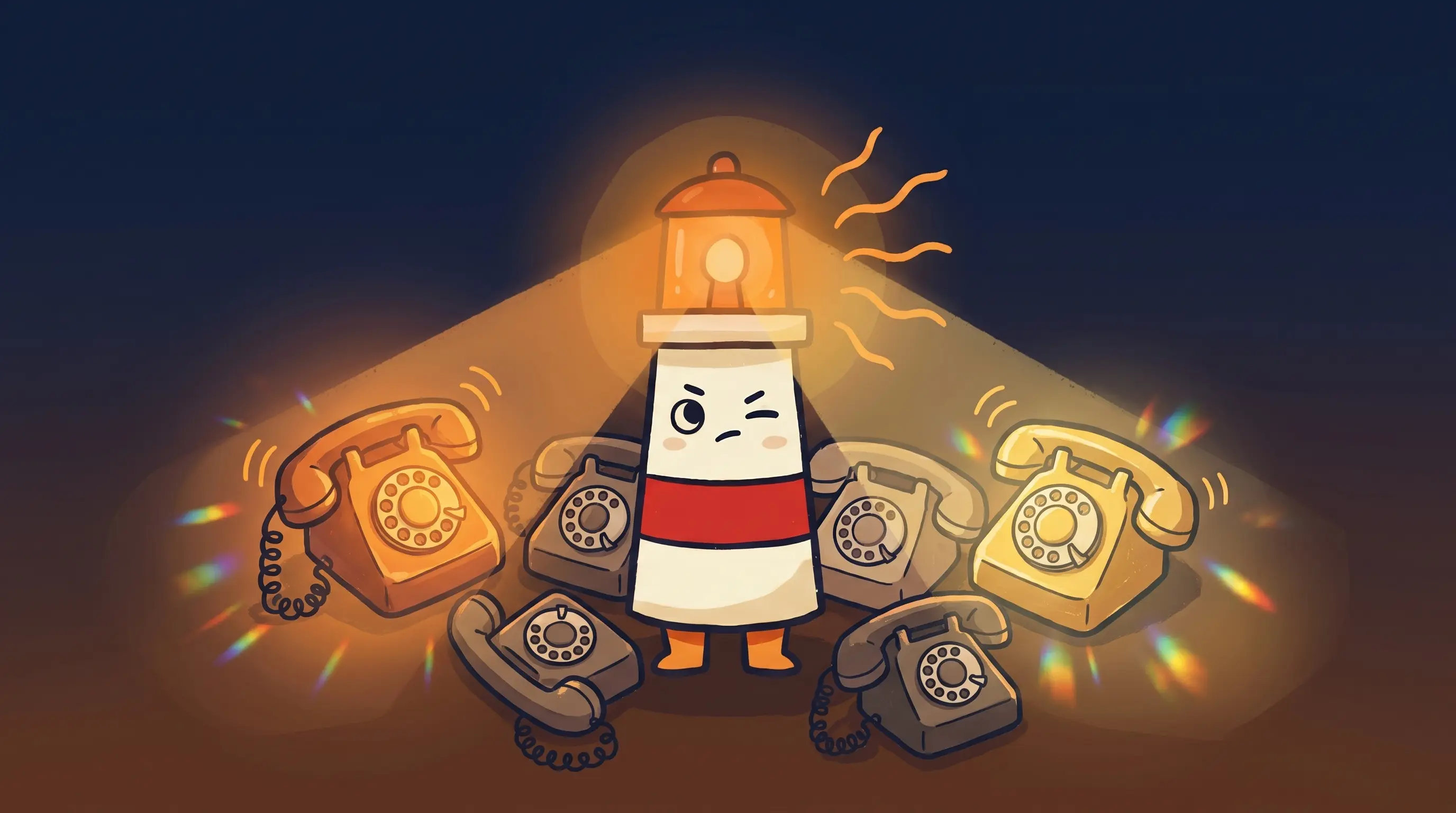
 Even a team of one can illuminate every angle — with the right tools doing the research.
- Orchestrator scope creep — The parent agent starts doing research work instead of delegating. Symptom: child agents idle, briefings come entirely from the orchestrator. Fix: restrict the orchestrator to routing and synthesis only.
- Hallucinations in synthesis — The synthesis layer fills gaps with plausible-sounding information instead of flagging unknowns. Clinical benchmarks found that even well-designed agentic systems filter only about 89.9% of hallucinations internally — the rest gets through. Add a rule: any synthesis output that cites a source must include the URL. Sourceless claims get flagged, not published.
- Tool sprawl before the core works — Adding integrations before the base two-agent system is stable. You can’t debug five moving parts at once. Stabilize before you scale.
- No memory between sessions — Agents that start fresh every run can’t build on prior research. Use persistent storage so your market intelligence agent remembers what it flagged last Tuesday.
- Briefings nobody reads — If you’ve built a research team that reports to a dashboard you open twice a month, it’s not saving you time. Route outputs to where you already live: your phone, your inbox, your Slack.
Your Monday Morning Build Checklist
This is where you start. Not with the full five-agent system — with the smallest possible working version.
- List your three most repetitive research tasks from last week. Write input, output format, and frequency for each. (15 minutes)
- Choose your framework: CrewAI if you want faster setup, LangGraph if you want more state control. Install it and run the quickstart example until it works. Don’t build anything custom yet. (60–90 minutes)
- Build one specialist agent for your most boring, well-defined research task. Test it against five real examples. If accuracy is below 70%, rewrite the role description before touching anything else. (2–3 hours)
- Set a hard API usage cap at $20/month. If you’re on OpenAI, set this in the dashboard before your agent runs overnight for the first time. Non-negotiable.
- Add a failure alert: if your agent doesn’t deliver a briefing on schedule, you get a notification. Build this before adding your second agent.
- If your first agent runs reliably for 5 days straight, add the orchestrator and your second specialist. Not before.
- Route your first briefing to WhatsApp or your primary messaging app — not a dashboard. If you have to go somewhere special to see results, you’ll stop checking within two weeks.
Solo-founded companies now make up 36.3% of all new startups — the highest share in more than 50 years, according to Carta’s 2025 Solo Founders Report. The ones building multi-agent research teams aren’t doing more work. They’re doing different work. The research runs. They make decisions. That’s the whole game.
Start with one agent. Get it boring-reliable. Then build the team around it.
What This Means for Your Research Operations
- A multi-agent research team separates your parent orchestrator from specialist child agents — this separation is what drives output quality, not the choice of AI model
- Token usage explains 80% of multi-agent research performance variance; improving how much relevant context each agent receives matters more than upgrading your AI model
- Early adopters of this architecture report recovering 20–50 hours per week from manual research, monitoring, and synthesis work
- The minimum viable stack is one framework (CrewAI or LangGraph), one AI provider API key, one web search integration, and one document storage integration — start here, add from gaps
- Build failure alerting and API usage caps before you build your third agent — silent failures and surprise invoices are the two most common reasons founders abandon these systems in week two
- The global agentic AI market surpassed $9 billion in 2026, with adoption among small businesses forecast to exceed 65% by end of year — the window to build a competitive advantage with this architecture is open now, not later
Frequently Asked Questions
How many AI agents does a solo founder actually need to run a research team?
Start with one specialist agent and an orchestrator — that’s a functional two-agent system. Most solo founders reach a useful steady state with four to six agents: an orchestrator, a market intelligence agent, a research synthesis agent, a content research agent, and a lead intelligence agent. Beyond six, you’re managing a system rather than running one. Add agents when you have a specific, well-defined research task that isn’t covered — not because adding more feels productive.
Which AI framework is best for solo founders building a multi-agent research system?
CrewAI for faster setup and a gentler learning curve; LangGraph for more control over agent state and memory management. LangGraph leads overall adoption (roughly 27,100 monthly searches vs CrewAI’s 14,800 according to Langfuse’s framework data), but adoption volume doesn’t equal fit for your use case. If you’ve never built an agent system before, start with CrewAI. If you need complex memory or branching logic in your research flows, LangGraph is worth the steeper ramp.
What does a multi-agent AI research system actually cost per month?
The framework itself (LangGraph or CrewAI) is open source — no cost there. Your main expenses are API costs (typically $8–$20/month for a well-configured solo research team with usage caps set) and hosting ($0 if self-hosted on infrastructure you already run, $29–$60/month for a managed platform). Total range: $8–$80/month depending on your choices. The more frequently your agents run and the longer their context windows, the higher your API spend. Set a hard monthly cap before your first agent goes live.
How do I prevent my AI research agents from making things up?
Two rules: every synthesis output that makes a factual claim must include a source URL, and sourceless claims get flagged rather than delivered. Agentic systems filter the majority of their own errors internally, but some still get through — the safeguard isn’t catching everything, it’s making traceability mandatory. Also: give agents specific, bounded research tasks rather than open-ended questions. ‘Find three recent news stories about [competitor] from the last 30 days’ produces more reliable outputs than ‘research [competitor] and tell me what’s interesting.’
How is a multi-agent research system different from just using ChatGPT?
The technology behind ChatGPT — the AI itself — may be similar. The difference is in how the system is deployed. ChatGPT waits for you to open it and type a prompt. A multi-agent research system runs on a schedule, delegates work to specialists, and delivers structured results without your involvement. It’s the difference between a search engine you visit and an analyst team that works overnight. The value isn’t in the AI model — it’s in the architecture that makes it autonomous.
Related BrainRoad guides
Sources
- OpenClaw Solo Founder Setup — Solvea
- Solo Founder Multi AI Agents Playbook — Xian Li on Substack
- How to Build an AI Agent: Complete Guide 2026 — The AI Corner
- Benchmarking LLM-based Agent Systems — Nature
- Evaluating Multi-Agent Systems in Enterprise Tool Use — Snorkel AI
- Minimum AI Stack for Bootstrapped Solo Founders — AI Shortcut Lab
- The Solo SaaS Founder Playbook for 2026 — Awesome Agents
- Best Multi-Agent Frameworks in 2026 — GuruSup
- GPT-5.4 vs Gemini 3.1 Pro vs Claude Opus 4.6 Comparison — AI Tool Briefing